A solid B2B social media strategy isn't about chasing likes. It’s about creating a direct line between what you post and what your business actually achieves. Forget vanity metrics. The real focus should be on measurable goals like generating qualified leads, building undeniable thought leadership, and making the sales cycle shorter. This mindset makes sure every piece of content, every ad dollar, serves a purpose.
Building a Foundation for Real Business Impact
Too many B2B companies treat social media like a digital billboard. They broadcast product features into the void and then wonder why no one’s listening. The problem isn’t the platform; it’s the absence of a real strategy that’s hardwired to business objectives.
Likes and shares feel good, but they don't move the needle on ARR or cut down customer churn. An effective strategy is built on purpose.
This means you have to start with the end goal in mind. Before you even touch a content calendar, you need to ask the tough questions. What are we actually trying to do here? Is it lead gen? Is it becoming the undisputed authority in our space? Or is it keeping the customers we already have? Each goal demands a completely different playbook.
A SaaS company trying to book more demos will run a totally different strategy than one focused on becoming the go-to resource for industry compliance. The first needs content that drives immediate action. The second needs to play the long game, building trust with high-value, educational content.
Tying Social Goals to Business Outcomes
The trick is translating those high-level business goals into specific, measurable social media objectives. This is how you draw a straight line from your daily tasks to the company’s bottom line. You stop posting just to post and start creating with intention.
This translation step is where most strategies fall flat. You need to understand how social media actually influences the B2B buyer's journey.
To help connect the dots, here’s a simple framework for translating high-level business goals into specific social media KPIs.
Connecting Social Media Objectives to SaaS Business Goals
Using a framework like this transforms social media from a fuzzy cost center into a predictable engine for growth.
A B2B social media strategy without clear, measurable goals is just a hobby. Anchoring every action to a specific business outcome is the only way to justify investment and prove ROI.
Setting SMART Goals for Your B2B Strategy
To make these objectives truly actionable, use the SMART framework: Specific, Measurable, Achievable, Relevant, and Time-bound. Vague goals like "increase brand awareness" are impossible to track and even harder to justify. If you're looking for a deeper dive into laying this groundwork, this guide offers a comprehensive B2B social media strategy.
Instead, a proper SMART goal sounds like this: "Increase demo requests generated from LinkedIn by 20% in Q3 by promoting customer success stories and targeted ad campaigns."
This goal is crystal clear. You know exactly what you're measuring, the timeline you're working against, and the tactics you'll use to get there. This level of clarity is non-negotiable if you want to build a strategy that delivers real business impact from day one.
Finding Your Audience and Where They Hang Out
A great B2B social media strategy isn't about shouting from every rooftop. It’s about joining the right conversations in the rooms where your customers are already gathered. Spraying your message across every platform is a surefire way to burn through your budget with little to show for it.
Instead, the goal is to focus your efforts with surgical precision.
This all starts with a deep, almost obsessive, understanding of your Ideal Customer Profile (ICP). For SaaS, this goes way beyond simple demographics. You need to map the entire buying committee within your target accounts.
Defining Your SaaS Buying Committee
In a typical B2B SaaS sale, you're not selling to one person. You're convincing a team. Pinpointing these key players is the first step toward creating content and choosing channels that actually resonate with each of them.
- The Decision-Maker: This is usually a C-suite exec or VP who holds the budget. They care about ROI, strategic alignment, and business impact—not the nitty-gritty product features.
- The Champion: This is your internal advocate, the person feeling the pain your software solves most acutely. They need practical content, like case studies and ROI calculators, to build a business case for you.
- The End-User: These are the people who will be in your software every day. They care about usability, efficiency, and how your tool makes their job less of a headache. Their buy-in is critical for adoption and retention.
Once you know these roles, dig into their daily lives. What newsletters do they actually read? Which podcasts are on their commute playlist? Who are the industry leaders they follow on LinkedIn? Answering these questions builds a three-dimensional picture of your audience, turning a generic profile into a real person.
To get these insights without just guessing, you need to listen to online conversations. Check out our guide on the best social listening tools comparison to find the right software for the job.
Mapping Your Audience to the Right Platforms
With a clear ICP, choosing your channels becomes a logical exercise, not a blind guess. You go where your audience is already active and engaged.
This simple flow chart shows how everything—from your high-level goals down to the KPIs you track—should connect.
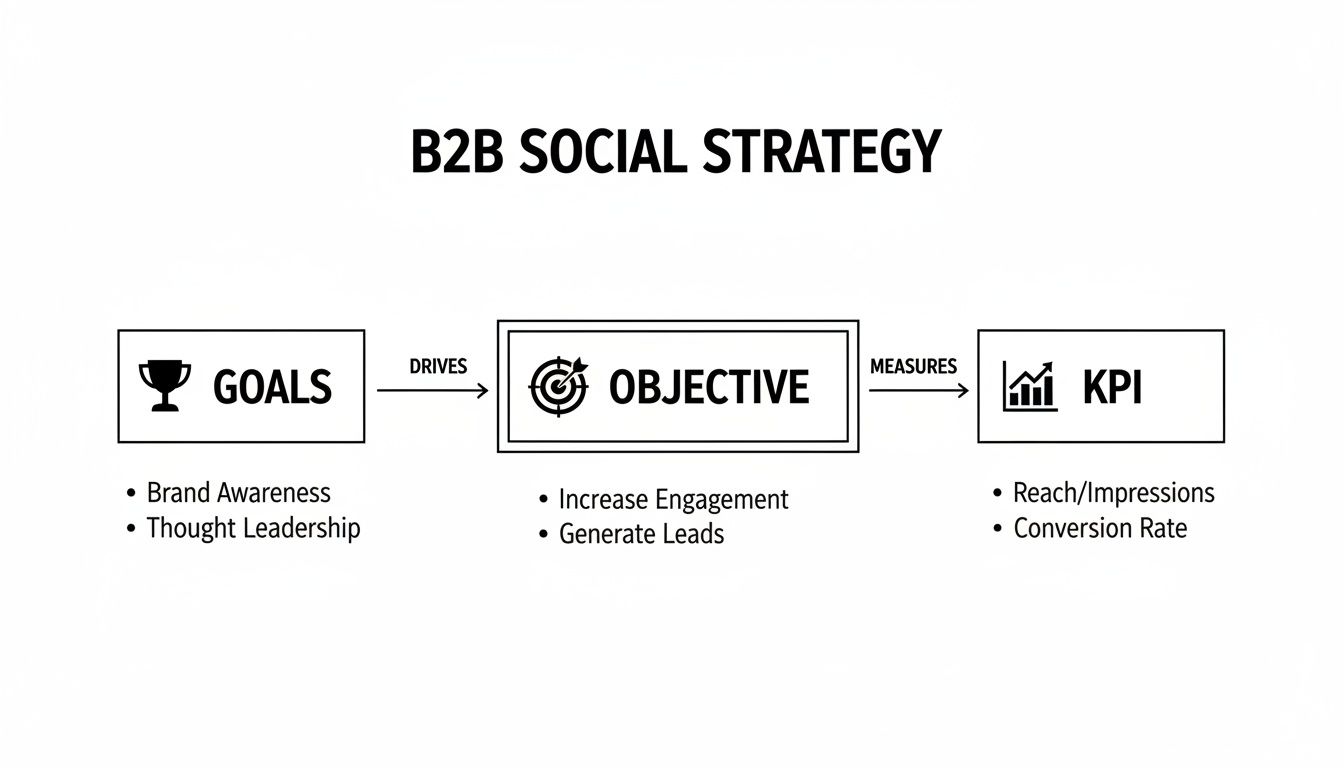
This model is a good reminder that every choice, including which platforms you use, has to directly support a measurable business objective.
For B2B SaaS, some channels are foundational, while others offer unique opportunities for much deeper engagement.
LinkedIn: The Professional Powerhouse
Let’s be clear: LinkedIn is the non-negotiable cornerstone of nearly every B2B social media strategy. Its professional context makes it the perfect place to reach decision-makers, share genuine thought leadership, and run hyper-targeted ad campaigns based on job titles, company size, and industry.
It's the central pillar for B2B marketers for a reason. By 2025, somewhere between 86% and 95% of B2B marketers will list LinkedIn as a primary platform. This overwhelming adoption translates directly into results, with some reports attributing 70–80% of B2B social-sourced leads directly to the platform.
Pro Tip: Don’t just post on LinkedIn—participate. The real value comes from engaging in industry discussions, dropping thoughtful comments on your prospects' content, and positioning your key executives as accessible experts.
Beyond LinkedIn: Niche Communities
While LinkedIn is essential, your most valuable conversations might happen in smaller, more focused communities. These are the places where technical buyers and end-users ask candid questions and share unfiltered feedback.
- Reddit: Subreddits like r/sysadmin, r/sales, or r/marketing are goldmines. This is where you can learn the exact language your customers use to describe their problems, spot emerging trends, and offer genuine help without a hard sales pitch.
- Industry-Specific Slack/Discord Groups: These private communities offer direct lines to highly engaged professionals. Participating here isn't about promotion; it's about becoming a trusted member of the community by providing real value and expertise.
Choosing the right mix of broad-reach platforms like LinkedIn and niche communities lets you build authority at scale while also fostering the authentic connections that drive long-term loyalty and trust. This balanced approach ensures your message reaches both the corner office and the front lines.
Creating a B2B Content Engine That Resonates

Alright, you know who you’re talking to and where they hang out. Now for the most important part: what are you actually going to say?
In B2B, content isn't just about making noise. It's the currency of trust and the engine of your entire social media strategy b2b. Sophisticated buyers don't care about flashy ads; they care about value. Your job is to build a system that consistently produces content that educates, solves problems, and quietly proves your product is the real deal.
This isn't about chasing one-off viral hits. It’s about becoming an indispensable resource they can't afford to ignore.
The Core Content Pillars for B2B SaaS
A balanced B2B content strategy stands on a few key pillars. Mixing these up is how you nurture prospects at every stage, from “who are you?” to “take my money.” It also keeps your feed from turning into a monotonous sales pitch.
Think of these as the foundation for a content calendar that actually works.
Thought Leadership: This is where you build authority. It’s your CEO’s bold prediction, an in-depth analysis of an industry shift, or a unique point of view on a common problem. It’s not about your product; it’s about proving you understand your customer’s world better than anyone.
Educational Content: This is your practical, how-to stuff. Think short video tutorials, quick tips that solve a nagging pain point, or a simple breakdown of a complex process. This content delivers immediate value and positions you as a helpful expert.
Proof of Value: This is all about validation. Customer success stories, detailed case studies, and glowing testimonials live here. This content answers the one question every B2B buyer has: "Does this actually work for companies like mine?"
If your current content feels stale, it might be time for a change. It's worth learning from others who have succeeded in overhauling your social media content strategy to drive better results.
Embracing Modern Content Formats
The way B2B buyers consume content has completely changed. Long-form articles still have a place, but the shift to visual and short-form content is undeniable. If you’re not adapting, you’re getting left behind.
In fact, the rise of short-form video has moved it from an experiment to a core part of the B2B playbook. Data shows that somewhere between 68–89% of companies now use video in their marketing, with many citing it as their highest-ROI social tactic.
Your B2B content doesn't need to be boring. The best stuff translates complex technical features into tangible business outcomes, often using simple, relatable visuals.
Building a Practical Content Calendar
A content calendar is more than just a schedule—it’s your strategic map. It helps you balance your content pillars and ensures you’re delivering consistent value without spamming your audience with sales pitches.
A simple, effective way to do this is the 4-1-1 rule.
For every six posts you publish:
- Four should be educational or thought leadership content.
- One should be a "soft promotion" like a customer story or case study.
- One can be a "hard promotion" pointing to a demo, trial, or free tool.
This structure keeps your feed focused on giving, not taking—which is the secret to building a loyal B2B following.
The Art of Content Repurposing
Creating great content from scratch is a heavy lift. The secret to a sustainable content engine is mastering the art of repurposing. One big piece of content can be sliced and diced into dozens of social media assets.
Here’s a real-world example:
Primary Asset: A one-hour webinar with an industry expert.
Repurposed Assets:
- 10-15 Short Video Clips: Pull out key insights and memorable quotes for LinkedIn, X, and YouTube Shorts.
- 5 Quote Graphics: Design sharp-looking graphics with the most powerful statements.
- 1 Blog Post: Write a summary of the webinar's key takeaways, and embed the full recording.
- 1 LinkedIn Article: Have your executive write a personal reflection on the main topic.
- 1 Carousel Post: Break down a key framework from the webinar into a multi-slide post for LinkedIn.
This approach maximizes the ROI on your best work, letting your team work smarter, not harder. To kickstart your brainstorming, check out our guide on B2B content creation ideas. A system like this creates a reliable flow of high-impact material that keeps your audience coming back for more.
Engaging Your Community and Amplifying Your Message
Look, creating great content is the first step, but it's only half the battle. If you just post it and walk away, you’re leaving the most important part of your social media strategy b2b on the table.
The real magic happens in the follow-through—when you actively engage with your community and find smart ways to amplify your message. This is the daily grind that turns your social channels from static billboards into living, breathing hubs for real connection. It’s all about finding that perfect balance between organic community building and smart, targeted advertising.
Finding the Right Mix of Organic and Paid Social
Let’s be honest: organic reach on most platforms has been in a nosedive for years. If you rely only on free posts, your best content might never even be seen by most of your followers, let alone new prospects.
This is where a strategic paid social budget becomes a necessity, not a nice-to-have.
Paid social is now a core part of the B2B playbook. By 2025, it's expected that somewhere between 70% and 83% of B2B marketers will be investing in paid social ads. This isn't a surprise—it's a direct response to the fact that organic reach alone just doesn't cut it for consistent growth anymore. Smart marketers are combining paid campaigns with retargeting and intent data to nail their conversions. You can find more in-depth B2B social media marketing statistics to see the full picture.
But this doesn't mean organic is dead. Far from it. The two are designed to work together.
- Organic: This is how you build trust, foster a real community, and show you're authentic.
- Paid: This is how you guarantee reach, target specific buyer personas, and speed up lead generation.
Here’s a pro tip: your best-performing organic content is the perfect signal for what to put ad spend behind. If a post is already getting love from your current audience, a paid boost can amplify its impact in a massive way.
Deploying Your Ad Spend with Precision
For any B2B SaaS company, LinkedIn Ads is the undisputed champion of paid social. Nothing else comes close. Its targeting capabilities are so granular you can zero in on prospects with a level of precision other platforms just can't match.
But don't just "boost post." A more sophisticated approach uses different campaign types for specific goals.
Using a mix like this ensures your budget is working as hard as possible at every single stage of the buyer's journey.
Moving Beyond Replies to True Community Engagement
While paid ads deliver scale, it's genuine community engagement that builds the kind of loyalty that pays off for years. This means doing more than just replying to comments on your own posts.
Real engagement is about becoming an active, helpful member of your industry's online ecosystem.
The goal is to be known as a valuable contributor, not just a brand that sells something. Your social channels should feel like a resource center, not just a storefront.
This takes consistent, proactive effort. Here’s how you do it:
- Engage with Target Accounts: Follow your top 20 target companies and the key decision-makers within them. Don't just lurk—leave thoughtful, insightful comments on their posts. It's the best way to get on their radar without being salesy.
- Participate in Industry Hashtags: Monitor and contribute to conversations happening around key industry hashtags. Jump in, offer your expertise, and answer questions without pitching your product. Just be helpful.
- Amplify Your Team: Encourage and celebrate when your own team members share their expertise online. A post from a product manager or an engineer often carries far more authenticity and weight than one from the official corporate page.
This is the human element that no amount of ad spend can ever replicate. It’s what transforms a passive audience into a thriving community of advocates who will eventually become your customers.
Measuring What Matters and Optimizing for Growth

You've built the strategy, created the content, and engaged the community. Now for the million-dollar question: is any of it actually working?
A successful social media strategy b2b doesn't run on hope; it runs on data. Proving your efforts are moving the needle is how you secure budget, earn trust from leadership, and turn social into a predictable growth engine.
This means we have to stop chasing vanity metrics. Follower counts and likes are nice, but they don't pay the bills. In the world of B2B SaaS, the only metrics that truly matter are the ones you can trace back to revenue.
Connecting Social Activity to Business Results
The first step is drawing a straight line from a social media post to a business outcome. The most reliable way to do this is with UTM parameters. They’re simple tags you add to your URLs that tell your analytics tools exactly where your traffic is coming from.
When a prospect clicks a UTM-tagged link in your LinkedIn post, you see their entire journey. You’ll know they came from social, which specific post they clicked, and what they did on your site. This simple tool is the absolute key to attribution.
Without it, all that hard-earned traffic gets dumped into a vague "Direct" or "Referral" bucket, making it impossible to prove your impact.
Tracking the Metrics That Actually Matter
Once your tracking is solid, you can focus on the KPIs that make a B2B leadership team sit up and listen. Forget about impressions; start talking about pipeline.
Here are the essentials to build your reporting around:
- Social-Sourced Traffic: How many unique visitors are your social channels sending to your website? This is a top-level indicator of reach and interest.
- Cost Per Lead (CPL): For paid campaigns, this is your north star. It tells you exactly how much you're spending to acquire one lead, letting you compare social's efficiency against channels like SEO or paid search.
- Social-Driven Demo Requests: This is a bottom-of-the-funnel metric that directly ties social activity to sales opportunities. How many people who came from social filled out your demo form? This is gold.
- Pipeline Influence: This one is more advanced but incredibly powerful. It tracks how many sales opportunities in your CRM had a social media touchpoint somewhere in their journey. It proves social is helping nurture and close deals, even if it wasn't the very first or last click.
The goal isn't just to report on activity; it's to report on impact. Frame your data in the language of the business—leads, pipeline, and cost-efficiency. That's how you communicate real value.
For a deeper dive, our guide on measuring marketing campaign effectiveness provides a solid framework you can adapt for your social efforts.
The Essential B2B Social Media Metrics Dashboard
Your report shouldn't be a data dump. It should be a concise, strategic document that tells a clear story for stakeholders who only have five minutes. A simple dashboard can help you communicate value quickly and effectively.
This structure focuses on what leadership cares about most—results and the plan for improvement. It cuts through the noise and gets straight to the point.
The Data-Driven Optimization Loop
Measurement isn't a one-and-done task; it's a continuous cycle. The data you collect is only valuable if you use it to make smarter decisions. This is the optimization loop that separates stagnant strategies from high-growth ones.
This process should happen like clockwork.
- Analyze the Data: At the end of each month, review your report. What content resonated the most? Which channels drove the most qualified leads? Where did you see the lowest CPL?
- Find the "Why": Look for insights behind the numbers. Did video on LinkedIn crush static images? Did a post about a specific pain point drive more engagement than a product feature announcement?
- Formulate a Hypothesis: Based on your insights, create a simple hypothesis to test. For example: "If we create more short-form video tutorials, we can lower our CPL on LinkedIn."
- Test and Iterate: Put your hypothesis into action in next month's content plan. Double down on what's working and ruthlessly cut what isn't.
This data-driven feedback loop is what transforms your social media from a hopeful experiment into a predictable, scalable engine for business growth. It ensures every post, every campaign, and every dollar spent is more effective than the last.
Your B2B Social Media Questions Answered
Even the best-laid plans come with questions. When it comes to B2B social media, a few common ones pop up again and again.
Here are the answers to the questions we hear most often from SaaS leaders.
How Much Should We Budget for B2B Social Media?
There’s no magic number, but a smart starting point is 10-20% of your total marketing budget.
That range gives you enough runway to blend organic content with paid amplification—both are non-negotiable for a modern B2B social media strategy.
Plan for a huge chunk of that—often over 50%—to go directly into paid ads on platforms like LinkedIn. An early-stage startup might get by on sweat equity and scrappy organic content. But a growth-stage company needs a dedicated paid budget to scale reliably.
Ultimately, your goals dictate the cost. A brand awareness play is priced very differently than a hard-sell "book a demo" campaign. The best approach? Track your Cost Per Lead (CPL) like a hawk and benchmark it against your other marketing channels. That data will tell you if your social spend is pulling its weight or needs a rethink.
How Do We Create Engaging Content for a Technical Product?
A technical product isn't a roadblock; it’s a content goldmine. The trick is to stop talking about features and start talking about solving real-world problems. Your audience doesn't care about your feature list. They care about fixing their biggest headaches.
Your job is to translate complex technical jargon into tangible business outcomes. Show them how your tool saves time, reduces errors, or unlocks new revenue streams.
This is easier than it sounds. Here are a few ideas you can steal:
- Demo a Single Feature: Create short, punchy videos (under 60 seconds) that zoom in on one powerful feature. Don't try to boil the ocean. Just solve one problem, really well.
- Explain Industry Trends: Break down a complex industry trend with a simple article or a carousel post. Then, position your product as the logical next step for anyone facing that challenge.
- Leverage Internal Experts: Get your engineers and product managers on camera for an "Ask Me Anything" (AMA) session or have them co-author a deep-dive blog post. Their authentic expertise builds trust faster than any ad ever could.
The goal is simple: be helpful first, promotional second.
What Is the Role of Employee Advocacy?
Employee advocacy is your secret weapon for authentic, organic reach. Your team's combined network is almost always bigger, more diverse, and more trusted than your corporate brand page will ever be.
Think about it: posts from individuals on LinkedIn consistently crush brand posts in both engagement and reach.
Encourage your team—especially sales, leadership, and customer success—to share company content with their own spin. Don't just hand them a script. Empower them to be themselves. You can provide pre-approved posts to make it easy, but the real magic comes from their unique commentary.
A solid advocacy program does a few things at once. It puts a human face on your brand, extends your reach into networks you'd never access otherwise, and can even surface warm leads from personal connections a corporate page could never find.
At PimpMySaaS, we specialize in turning complex B2B SaaS products into topics of conversation on platforms like Reddit, enhancing your brand's visibility where it counts. Discover how we can get your brand cited in AI responses and drive targeted growth by visiting https://www.pimpmysaas.com.