Picking the right social listening tool isn't just a tech decision—it's a strategic move that separates the brands that lead from those that follow. A quick social listening tools comparison shows they all play different games. Brandwatch is a beast for deep historical data and research, Sprinklr offers an all-in-one suite for massive enterprises, and Brand24 delivers incredible value for small to mid-sized teams.
The best tool for you? It comes down to what you’re actually trying to accomplish, whether that’s dodging a PR crisis or digging for your next big product idea.
Why Smart Social Listening Defines Market Leaders
That image pretty much sums it up: social listening turns the firehose of raw online chatter into structured, actionable intelligence. This is way more than just counting mentions. It’s about getting to the "why" behind what customers are saying, what competitors are doing, and what trends are about to break.
Good listening gives you a direct line to the unfiltered voice of your customer.
From Data Points to Strategic Decisions
The real magic of these tools is their ability to find the signal in the noise. Without them, you're flying blind. Market leaders are tapping into these insights to drive critical business functions, and they're usually focused on a few key areas:
- Proactive Crisis Management: Spotting negative chatter and stamping out fires before they turn into full-blown reputation disasters.
- Product Innovation: Eavesdropping on forums and social threads to find the pain points and feature requests customers are talking about organically.
- Competitor Intelligence: Keeping a real-time pulse on what competitors are launching, how their campaigns are landing, and where their customers are getting frustrated.
- Campaign Optimization: Getting an honest read on how a marketing campaign is really being received, beyond vanity metrics like likes and shares.
This isn't just about marketing; it's a core part of building a resilient brand. To go deeper, check out our complete guide on online reputation management.
The real power of social listening is its ability to move a brand from a reactive stance to a proactive one. Instead of just responding to what has happened, you can anticipate what will happen next.
The Growing Importance of Listening
The demand for this kind of intelligence is exploding. The social listening market is on track to blow past USD 9.6 billion by 2025, and for good reason. Right now, 61% of businesses are already using these tools to get a handle on what their customers are thinking in real time.
Thanks to serious improvements in AI, sentiment analysis accuracy is hitting around 93%, meaning tools can now catch nuances like sarcasm and context with scary precision.
This shift makes one thing crystal clear: listening to the public conversation is no longer a "nice-to-have." It’s the foundation of modern marketing, customer service, and strategic planning. A solid social listening tools comparison is your first step in picking the right partner for the job.
How to Create Your Social Listening Evaluation Framework
Before you even look at a side-by-side tool comparison, you need to build your own evaluation framework. Without one, every platform's feature list will look impressive, and you’ll be stuck trying to make a confident decision. This framework is your personalized scorecard, forcing you to judge tools based on what actually matters to your business.
First things first: map your specific goals to the features you'll need. A tool is only as valuable as its ability to help you hit a target. For instance, a brand obsessed with preventing a PR crisis needs real-time alerts and nuanced sentiment analysis. A company focused on product innovation, on the other hand, needs deep insights from forums and product review sites.
Data Source Coverage and Depth
Not all data is created equal. Where a tool pulls its information from is a massive differentiator. Your audience isn’t just on one platform, so your listening tool shouldn't be, either. The goal is to evaluate both the breadth and the relevance of the data sources.
- Breadth of Coverage: Does it monitor the big players like Instagram and TikTok? What about professional hubs like LinkedIn, community forums like Reddit, and essential news sites or blogs?
- Relevance to Your Audience: A B2B SaaS company will care a lot more about LinkedIn and tech news monitoring. A D2C fashion brand? They need powerful visual monitoring on Instagram and Pinterest to track user-generated content and brand aesthetics.
Your framework should weigh data sources based on where your customers and competitors are most active. A tool with a million sources you don't need is less valuable than one with a hundred you do.
AI-Powered Analytics and Insights
Modern social listening isn't just about collecting mentions; it's about turning that raw data into strategic intelligence. The quality of a tool's AI engine is what separates basic monitoring from true listening. When you're assessing platforms, get granular with their analytical capabilities.
A key feature to dig into is the tool's sentiment analysis, which goes way beyond a simple positive/negative score. Look for platforms that can detect nuances like sarcasm and spot emerging emotional trends around your brand or industry keywords. That’s the real value.
Also, look for features like image and video analysis. This tech can spot your logo or products in visual content, even when there's no text mention. Trend analysis and predictive alerts are just as critical—they help you get ahead of conversations before they go mainstream. This level of deep analysis is a hallmark of the best competitor analysis tools on the market.
Integrations and Workflow Seamlessness
A social listening tool shouldn’t be an island. Its real power is unlocked when it connects to your existing tech stack—your CRM, business intelligence (BI) dashboards, or customer support platforms. This is how you turn insights into action.
Evaluate how cleanly a tool integrates with platforms like Salesforce, HubSpot, or Slack. Can you automatically generate a support ticket from a negative comment? Can you push sentiment data into your BI tool to see how it correlates with sales figures? A tool with robust integrations ensures the valuable data you collect gets into the right hands across your organization, empowering teams to act on it fast.
Head-to-Head Social Listening Tools Comparison
Choosing a social listening tool isn’t about finding the “best” one—it’s about finding the right one for your business. A platform built for enterprise-level market research is just expensive overkill for a startup trying to monitor brand health. This social listening tools comparison goes past the usual feature lists to show you how the top platforms actually perform in the real world.
We're going to break down the core strengths of market leaders like Brandwatch, Sprinklr, and Talkwalker, putting their capabilities into context. The goal is to match their unique powers—from deep AI analytics to unified customer experience—to the specific problems you're trying to solve. This should give you a much clearer path to picking a tool that fits your budget, team, and goals.
This infographic breaks down the three pillars that hold up any modern social listening platform: data sources, analytics, and integrations.
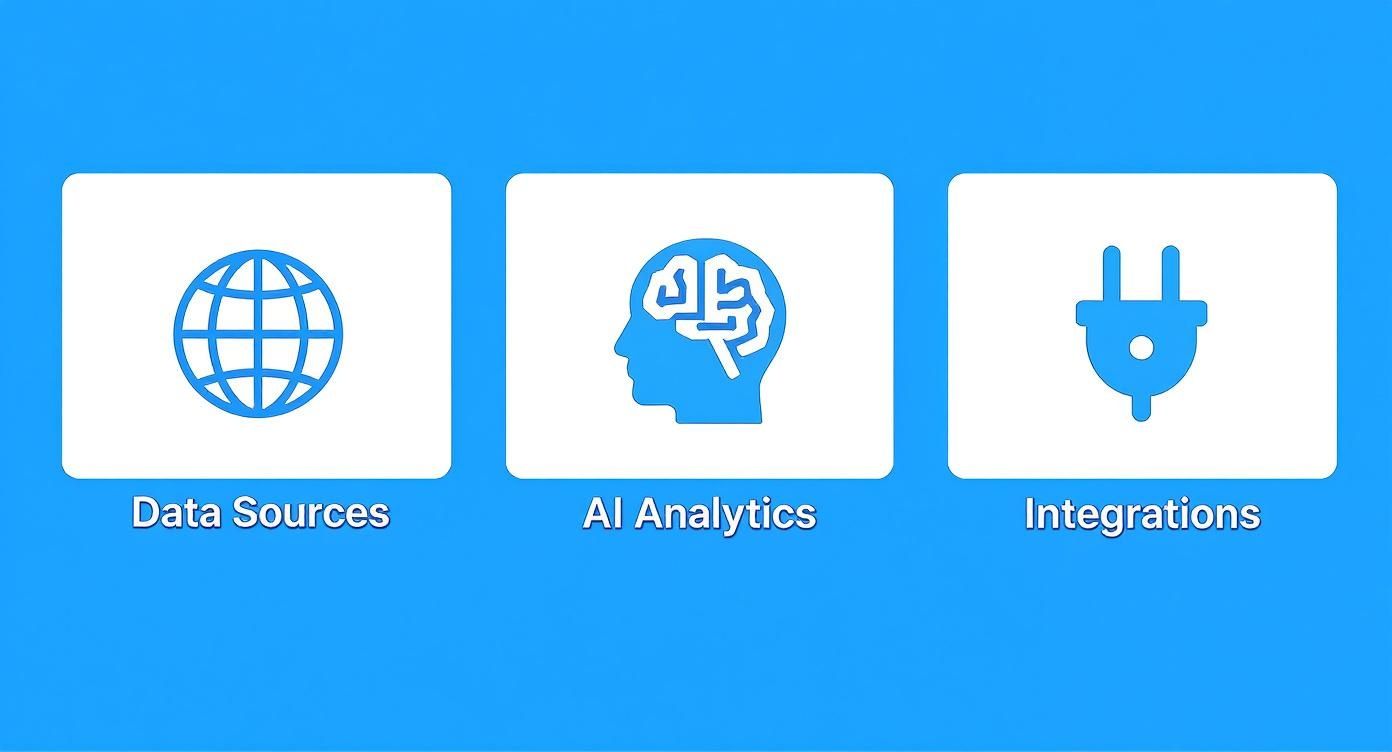
As you can see, a tool has to nail all three to turn random online chatter into intelligence you can actually use.
Brandwatch For Deep Research and Historical Analysis
Brandwatch has earned its reputation as the go-to platform for serious, data-heavy research. Its biggest flex is its massive historical data archive, holding over 1.7 trillion conversations going all the way back to 2010. This makes it an absolute beast for any organization that needs to run long-term trend analysis or deep-dive market research.
Think of a global CPG company eyeing a new market. With Brandwatch, they could analyze more than a decade of consumer talk around similar products. This lets them spot shifting tastes, cultural nuances, and old brand perceptions that newer, less data-rich platforms would completely miss.
Key Differentiator: Brandwatch’s power is its historical data library. If your main goal is to understand long-term trends, do academic-level research, or analyze market shifts over years, its depth is simply unmatched.
But all that power comes with a steeper learning curve. Building complex queries often means getting comfortable with Boolean logic. While it's incredibly flexible, it’s not a plug-and-play solution for teams who just want quick, surface-level insights. It’s really built for dedicated analysts and research teams.
Sprinklr For Unified Enterprise Customer Experience
Sprinklr doesn’t just call itself a listening tool; it's a unified customer experience management (Unified-CXM) platform. The whole idea is to replace dozens of separate tools—for social listening, customer service, marketing, and ads—with one single, connected environment. This makes it a serious contender for large, complex companies drowning in siloed data.
Picture a multinational airline. Using Sprinklr, a negative tweet about a flight delay gets picked up by the listening module, automatically sent to the right customer service agent (inside the same platform), and the sentiment data is fed back to marketing dashboards to adjust ad campaigns in real time. That seamless workflow is Sprinklr’s main draw.
This all-in-one approach is fueling major market growth. The social media listening market was valued at USD 9.2 billion in 2024 and is expected to hit over USD 20 billion by 2030. This boom is driven by demand for comprehensive platforms like Sprinklr that can manage the entire customer journey from start to finish.
Situational Recommendation:
- Choose Sprinklr if: You’re a large enterprise with different teams (marketing, sales, service) that all need to work from a single source of customer truth.
- Consider another tool if: You're a mid-sized company or a single department looking for a dedicated, nimble social listening tool without the complexity of a full CXM suite.
Talkwalker For Advanced Visual and AI Analytics
Talkwalker’s standout feature is its industry-leading image and video recognition. In a world dominated by visual platforms like Instagram and TikTok, just monitoring text isn’t enough anymore. Talkwalker's AI can spot logos, scenes, and objects in photos and videos, even when your brand isn't mentioned in the text.
For a D2C fashion brand, this is a game-changer. They can see how influencers and customers are actually styling their products in user-generated content, uncovering authentic use cases and potential brand ambassadors. This is a level of visual intelligence that text-based tools simply can't provide.
Talkwalker’s Blue Silk GPT and its advanced AI also drive predictive alerts and conversation clusters, helping teams see the why behind conversations and spot trends before they go mainstream.
This focus on AI isn't just limited to social listening. When you're looking at different tools, it's often helpful to see how AI features are evaluated in other fields, like in these guides that rank and compare AI video summary generator tools. You'll often find similar criteria, like accuracy, feature depth, and real-world applications.
Brand24 For Agile SMBs and Startups
While the enterprise giants fight it out at the top, Brand24 offers a fantastic solution for small to mid-sized businesses (SMBs) and startups. It gives you a solid set of core listening features—mention tracking, sentiment analysis, and influence scoring—at a price point that won't make your CFO cringe.
The interface is built for marketers who need to get going fast without weeks of training. A startup can set up alerts for their brand, competitors, and industry keywords and start pulling in insights in minutes. The storm alerts feature is especially clutch for small teams, pinging them when mention volume suddenly spikes so they can jump on a viral moment or a PR crisis.
Use Case Example:
A new B2B SaaS company could use Brand24 to monitor forums and social media for people complaining about their competitors. They can then take those insights and sharpen their own product messaging and sales pitches to directly address those known frustrations.
The "Discussion Leaders" feature is also great for finding influential people talking about a specific topic, making it perfect for discovering micro-influencers or brand advocates to partner with. It doesn't have the historical depth of Brandwatch or the unified workflow of Sprinklr, but Brand24 delivers incredible value for who it's built for.
Feature and Use Case Comparison of Leading Social Listening Tools
To really nail down your decision, it helps to see how these tools stack up side-by-side on the things that matter most.
The following table provides a side-by-side analysis of the top social listening tools, evaluating them on key features like data sources, analytics capabilities, integration options, and ideal business size.
This table makes the trade-offs crystal clear. If budget is tight and you need insights now, Brand24 is the obvious choice. If your mission is to unite a dozen customer-facing tools across a global company, Sprinklr was built for you. For brands driven by visual trends, Talkwalker gives you a unique edge, while Brandwatch is still the king of data-driven research. Your choice really just depends on which of these scenarios sounds most like yours.
Analyzing the True Cost and ROI of Social Listening

It’s easy to get fixated on the monthly fee you see on a pricing page, but that’s just the tip of the iceberg. A real social listening tools comparison digs deeper into the total cost of ownership and, more importantly, the potential return you’ll get from that investment.
The sticker price is just the start. To make a smart decision, you need to get a handle on the different pricing models out there and sniff out the hidden costs that can blow up your budget. Only then can you tie a tool’s features to actual business results and build a solid case for its value.
Decoding Different Pricing Models
Social listening tools don't have a one-size-fits-all price tag. Getting familiar with the common models is your first step to forecasting what you'll really spend and avoiding nasty surprises down the road.
Tiered Plans (Most Common): These plans usually scale up based on users, the number of keywords or topics you're tracking, and how many mentions you collect each month. A starter plan might give you 2 users and 5,000 monthly mentions, while an enterprise tier offers unlimited everything.
Per-Mention or Data Consumption Models: Some platforms bill you based on how much data you use. This can be great if your monitoring needs go up and down, but it can also lead to unpredictable bills if a PR crisis hits or a campaign goes viral.
Custom Enterprise Pricing: High-end platforms like Sprinklr or Brandwatch often require you to get a custom quote. This pricing is built around your specific needs, like adding premium data sources (think print or broadcast media), API access, and a dedicated support team.
Don't forget to ask about hidden costs. Onboarding fees, charges for premium integrations, extra user training, and fees to access historical data can all add up.
A tool that looks like a bargain upfront can quickly become a money pit if its limitations force you into constant, expensive upgrades. Always measure a platform’s pricing tiers against where you see your business in the next 12-24 months.
Calculating the Real Return on Investment
Measuring the ROI of a social listening tool is all about connecting its features to tangible business goals. It's time to move past vanity metrics and focus on how listening-driven insights actually impact your bottom line. Nailing this calculation is a key skill, and you can dive deeper into the strategies in our guide on how to measure marketing ROI.
There's a reason this market is booming. Businesses are successfully connecting these platforms to real value. The global social listening tools market, valued at around USD 3.0 billion in 2025, is expected to hit roughly USD 6.4 billion by 2033. This growth is all about companies using these tools to drive results and see a real return. For more on this trend, you can find the full market analysis on Archive Market Research.
Here’s a practical way to think about your potential ROI:
- Averted Crisis Costs: Think about the financial hit of one PR disaster. If your tool’s real-time alerts help you stop even one major incident, it could pay for itself for years to come.
- Improved Campaign Performance: Use listening insights to fine-tune your ad spend. If sentiment analysis helps you shift just 10% of your budget from a failing campaign to a winning one, that saving is a direct return.
- Reduced Customer Churn: Find and proactively solve customer complaints you spot online. Cutting churn by even a tiny percentage translates directly into retained revenue.
- Lead Generation: Uncover sales opportunities by monitoring conversations where people are complaining about a competitor or asking for recommendations. Every lead you convert adds to the tool's ROI.
How to Choose the Right Tool for Your Business
After comparing all the top social listening tools, one thing is crystal clear: there’s no single “best” platform. The right choice comes down to your company’s specific goals, the size of your team, and your budget. This final step isn't about picking the tool with the most features; it's about matching your business needs to the platform that will actually deliver value.
Let's skip the generic advice and get into specific, situational recommendations. This will help you pick a platform that becomes a real strategic partner, turning online chatter into measurable results. Think of this less as a software purchase and more as an investment in intelligence.
For Global Enterprises Needing Deep Intelligence
If you're a large, multinational organization, your needs are in a different league. You’re juggling multiple brands across various regions, which demands deep competitive intelligence, historical trend analysis, and a platform that can process massive amounts of data without breaking a sweat.
For this, Brandwatch is the standout. Its secret weapon is a massive historical data archive of over 1.7 trillion conversations. This lets your market research teams run long-term analyses that are just not possible on other platforms. You can literally track shifting consumer sentiment over years, not just weeks, giving you a solid foundation for major strategic decisions.
Situational Fit: Choose Brandwatch if your main goal is deep market research, long-term trend analysis, or academic-level competitive intelligence. It's built for dedicated analyst teams who need granular control and access to an unmatched historical dataset.
On the other hand, if your priority is to unify dozens of separate customer-facing tools into one place, Sprinklr is the answer. It’s less of a standalone listening tool and more of a complete customer experience management platform, perfect for coordinating marketing, sales, and service across a massive enterprise.
For Agile B2C Brands Focused on Engagement
For fast-moving B2C companies—especially in visual industries like fashion, beauty, or CPG—the game is all about speed and visuals. Your priority is real-time customer engagement, finding user-generated content, and spotting trends as they happen. Just monitoring text won't cut it.
This is where Talkwalker shines. Its industry-leading image and video recognition gives you a serious advantage. It can spot your logo or products in an Instagram story or a TikTok video even when your brand isn’t tagged, uncovering authentic moments that other tools would completely miss.
This kind of visual intelligence is gold for:
- Finding authentic user-generated content for your marketing campaigns.
- Spotting emerging micro-influencers and genuine brand fans.
- Seeing how customers are actually using or styling your products in the wild.
Talkwalker's predictive alerts also help you jump on viral trends before they blow up, which is a massive advantage for any brand trying to stay culturally relevant.
For Startups and SMBs Requiring Scalable Monitoring
If you're a startup or a small to mid-sized business (SMB), your resources are probably tight. You need a powerful tool that’s easy to use and delivers value right away, without needing a dedicated analyst or a six-figure budget. Your focus is on the essentials: brand health monitoring, keeping an eye on competitors, and finding sales opportunities.
Brand24 is perfectly built for this. It gives you the core features you need—mention tracking, sentiment analysis, and influence scoring—in an affordable and intuitive package. Its "Storm Alerts" are especially useful for small teams, sending you a notification when mention volume spikes so you can quickly handle a PR fire or lean into a positive viral moment.
Decision Checklist: Before you sign anything, run through these final questions to make sure you've got the right fit.
- Goal Alignment: Does this tool’s main strength directly help my #1 business goal (e.g., market research, crisis management, lead gen)?
- Team Capacity: Is my team actually equipped to use this? Do we need a simple interface, or can we handle complex Boolean queries?
- Data Relevance: Does it monitor the specific channels where my audience hangs out (e.g., Reddit, TikTok, news sites)?
- Scalability: Will this tool grow with us over the next 18-24 months, or are we going to outgrow our plan in six?
- Integration Needs: Does it play nicely with our existing CRM, BI tools, or customer support software?
Answering these questions honestly will point you to the platform that not only fits your needs today but will also support you as you grow.
Common Questions About Social Listening Tools
Diving into a social listening tools comparison always brings up a few key questions. It's one thing to look at a feature list, but it's another to understand how these platforms actually work day-to-day.
Let's clear up some of the most common points of confusion, from buzzwords to implementation timelines.
What Is the Real Difference Between Social Listening and Social Media Monitoring?
A lot of people use these terms interchangeably, but they’re two totally different things. The easiest way to think about it is this: monitoring is hearing, but listening is understanding.
Social media monitoring is purely reactive. It’s the act of collecting mentions of your brand or specific keywords. It answers the basic questions: what was said, where, and when. It's about gathering raw data.
Social listening, on the other hand, is proactive. You’re not just collecting mentions; you’re analyzing the why behind them. It’s about digging into the sentiment, trends, and motivations driving the conversation to inform your strategy, from product tweaks to competitive positioning.
Monitoring gives you a list of tweets. Listening tells you that 15% of those tweets are from frustrated customers pointing out the same bug, giving you a clear signal for your product team.
How Do Social Listening Tools Handle Data Privacy Regulations?
This is a big one, and rightly so. Any reputable social listening tool is built to comply with major privacy laws like GDPR and CCPA. They work by analyzing publicly available data—posts on social networks, forums, blogs, and news sites. They don't (and can't) scrape private profiles, DMs, or locked-down accounts.
To stay compliant, the best platforms do a few key things:
- They anonymize data: The focus is on macro trends, not individuals. They often aggregate data and strip out personally identifiable information (PII).
- They use official APIs: Tools access data through the official channels provided by social networks, which have strict rules about how that data can be used.
- They have clear policies: Top-tier tools are transparent about their privacy policies and data handling.
When you're comparing options, always check their compliance pages. It’s non-negotiable. This protects your business and shows respect for your customers' privacy.
How Long Does It Take to Implement a Tool and See Results?
This really depends on the tool's complexity and what you're trying to achieve.
A simple, user-friendly platform like Brand24 can be up and running in a few hours. Just plug in your keywords, connect your social profiles, and you’ll start seeing mentions and sentiment data flow in within the first 24 to 48 hours.
For more powerful enterprise platforms, you’re looking at a longer runway. Implementation might take several days or even a couple of weeks, especially if it involves team-wide training, customizing dashboards, and integrating with your CRM or other business intelligence tools.
But here’s the critical part: while raw data shows up almost instantly, real strategic insights take time. Give it at least 2-3 months. That's how long it usually takes to build up enough historical data to spot meaningful trends, fine-tune your strategy, and actually start measuring your ROI.
Ready to elevate your B2B SaaS brand's presence in key online discussions? PimpMySaaS specializes in strategic Reddit engagement that gets your brand noticed and cited by large language models like ChatGPT. Discover how we can amplify your voice at https://www.pimpmysaas.com.