
SaaS content marketing agencies aren’t just outsourced blog writers. They’re specialized partners who build and execute entire content strategies designed to drive revenue. Think of them as an integrated team of strategists, writers, and SEO experts—a critical growth lever for any SaaS company serious about becoming an authority in their market.
Why High-Growth SaaS Companies Hire Agencies

Most SaaS companies dip their toes into content with freelancers. It works well enough for getting individual articles published. But as a company scales, the goal shifts from just creating content to building a revenue-generating content engine. That’s the strategic gap a specialized agency is built to fill.
Hiring an agency isn't about offloading writing tasks. It’s about plugging in an entire, pre-built content department. This team comes with proven processes and strategic frameworks, ready to operate as a true extension of your marketing team from day one.
Beyond Just Content Production
The real value of a top-tier agency is its strategic oversight. They don’t just ask, “What blog post should we write next?” They’re asking the questions that actually matter:
- How does our content feed the sales pipeline? They’re obsessed with mapping content to business goals, like generating SQLs or driving down customer acquisition costs.
- What’s our unique point of view? They help you carve out a distinct perspective that makes you stand out and builds real brand authority.
- How do we actually win in search? They bring deep SEO expertise to the table, identifying keyword opportunities and building topical authority in a way freelancers rarely can.
For example, one of the biggest reasons high-growth SaaS companies partner with agencies is to build out a comprehensive results-driven LinkedIn marketing strategy for B2B that ensures their content is seen by the right decision-makers.
The Numbers Don't Lie
The data reveals a pretty significant performance gap. It turns out only 19% of SaaS businesses actually work with marketing agencies for their content, while a whopping 67% rely on freelancers.
Here’s the kicker: agency-backed companies see 2.3 times faster organic traffic growth compared to those trying to manage content in-house or with contractors. This massive difference is why 71% of SaaS companies with over $5 million in ARR outsource at least one content function to an agency.
The decision to hire an agency marks a shift from viewing content as a cost center to treating it as a strategic growth investment. It's about moving from a task-based approach to an outcome-driven one.
At the end of the day, fast-growing SaaS companies choose agencies because they need more than just words on a page. They need a scalable, repeatable system for turning content into a predictable source of qualified leads and new customers.
Before you even think about hiring a SaaS content marketing agency, you have to define your “why.” And I don’t mean vague goals like “more traffic” or “better content.” That’s a recipe for wasted money and disappointment.
To find the right partner, you need to know exactly what business outcome you’re trying to achieve.
Are you trying to slash your Customer Acquisition Cost (CAC)? Does your sales team need more SQLs to hit their quota? Or maybe you're trying to grab market share in a new vertical before your competitors even know what's happening. Each of these goals demands a completely different content strategy.
Getting this right is the most important thing you'll do. It turns a fuzzy wish list into a clear, targeted mission.
From Business Goals to Content KPIs
The next step is to translate those big-picture business goals into measurable content marketing KPIs. This is how you make sure an agency is actually delivering what you need, and it makes evaluating them so much easier.
Think of it this way:
- Content KPI: We need to generate 40% more MQLs from organic search over the next 12 months.
- Content KPI: Let's rank in the top 3 for 15 core keywords in that segment and drive 50 qualified demo requests from that content.
See the difference? This shifts the conversation from abstract ideas to tangible results. It also gives you a clear way to measure your content marketing return on investment as you go. Any agency worth its salt will appreciate this level of clarity—it shows them you’re serious about outcomes, not just output.
Figure Out Your Content Gaps
With your goals locked in, it’s time for a little self-assessment. Where are the real holes in your current content machine?
Most SaaS companies find the biggest value from agencies in two key areas: strategy and SEO execution. In fact, 43% of brands say that’s where agencies help the most. This makes sense, especially when you consider that 56% of in-house teams struggle with content consistency and 49% admit they just don’t have the strategic depth. An external partner can fill that gap perfectly. You can find more data on this at SaaS content agency performance.
Your internal brief should be a clear, concise document outlining your primary business objective, the specific KPIs you'll use to measure success, and the core strategic gap you need the agency to fill.
Having this figured out before you start taking calls is a total game-changer. It means every conversation is productive and focused on how an agency can solve your specific, well-defined problems. You won't just find a better partner—you'll set the stage for a killer collaboration from day one.
How to Find and Shortlist the Right Agencies

Alright, you know what you need to achieve. Now comes the hard part: sifting through the noise to find a partner who can actually deliver.
This isn't about a quick Google search and picking the top three results. It’s a deliberate process of separating the true SaaS specialists from the generalist agencies that just happen to have a "SaaS" landing page.
Start your search with specific, long-tail queries. Instead of "content agency," try "B2B SaaS SEO agency" or "content marketing for fintech startups." You'll also find hidden gems in industry reports, marketing communities, and even by seeing who your favorite SaaS brands are working with.
Digging Into Their Digital Footprint
An agency’s own content is their best sales pitch. If their blog doesn't impress you, how can you expect them to create standout content for your brand?
Take a hard look at their website and resources. Is the content sharp, insightful, and clearly written for a SaaS audience? Or is it generic, keyword-stuffed fluff? Real experts practice what they preach, and it shows.
Next, get into their case studies. Don't get distracted by vanity metrics like "increased organic traffic." You're looking for business results. An agency that boasts about driving a 25% increase in qualified demo sign-ups is speaking your language.
Pay close attention to who they've worked with. Do they have a proven track record with companies at your stage, in your niche? An agency that primarily serves enterprise giants probably won’t have the right playbook for a Series A startup that needs to be scrappy and move fast.
Separating Specialists from Generalists
Lots of agencies claim to "do SaaS." You need a team that truly lives and breathes it.
A real specialist understands the unique challenges of marketing software—from long, complex sales cycles to the critical importance of product-led growth. They get that content isn't just about keywords; it's about educating users and driving them toward activation.
Here’s how to spot a genuine SaaS specialist:
- They Speak the Language: Their website, case studies, and sales calls are filled with terms like ARR, LTV, SQLs, and product-led content. It’s their native tongue.
- Their Services are Focused: They aren’t a one-stop shop offering everything from TikTok management to PPC. Their core services revolve around content strategy, SEO, and pipeline generation for software companies.
- Their Team Has Real SaaS Experience: Check out the leadership and strategist bios on LinkedIn. Have they worked in-house at SaaS companies before? That hands-on experience is invaluable.
The best partners are true data-driven marketing agencies that tie every piece of content back to measurable business outcomes. If you want to go deeper on this, our guide on choosing a content strategy agency breaks down the strategic side even further.
A great agency doesn't just promise rankings; they promise pipeline. Their philosophy should be rooted in driving business outcomes, with content being the vehicle to get there.
Creating Your Agency Evaluation Checklist
To avoid getting swayed by a slick sales deck, you need an objective way to compare your top contenders. A simple checklist keeps you focused on what really matters.
I recommend setting up a simple spreadsheet to track the must-haves for your potential partners. This forces you to make an apples-to-apples comparison and grounds your decision in data, not just gut feelings.
Agency Evaluation Checklist
Use this table as a starting point to compare your shortlisted agencies side-by-side.
By the time you fill this out for a few agencies, your decision will likely become much clearer. The partner who scores highest on the criteria that matter most to you is usually the right choice.
Asking the Right Questions on a Discovery Call
The discovery call is where you separate the real strategists from the glorified content farms. Forget the polished sales deck for a minute. This is your shot to see how an agency thinks.
Your goal isn't just to hear a list of their services. It’s to get them talking about their process, their problem-solving chops, and how they actually partner with clients. Generic questions will get you generic, rehearsed answers. You need to dig deeper.
A top-tier agency will love this. A vendor just trying to close the deal? They’ll probably get flustered.
Probing Their Strategic Mindset
Start by asking questions that force them to talk strategy, not just tactics. You need to see a clear line connecting their content activities to actual business outcomes—not just fluff like "more traffic." Their answers here will tell you everything you need to know.
Here are a few of my go-to questions:
- "Walk me through a time a content strategy tanked and how you course-corrected." This one is gold. It reveals their honesty, how they handle accountability, and their process for fixing what’s broken. You’re listening for specific data points and tactical shifts, not vague excuses.
- "How do you make sure the content captures our unique point of view and doesn't sound like everything else out there?" This gets to the heart of their brand immersion process. A great agency will talk about interviewing your subject matter experts, dissecting competitor messaging, and building a unique content pillar strategy from the ground up.
- "Beyond traffic and rankings, how will you measure and report on success in the first six months?" If their answer doesn't immediately jump to pipeline metrics like MQLs, SQLs, and demo requests, it’s a massive red flag. Vanity metrics won't pay the bills.
Understanding Their Process and Communication
Okay, so they can talk strategy. But what’s it really like to work with them day-to-day? A brilliant plan is useless if the execution is a chaotic mess and you can never get a straight answer.
Ask them to get super specific about their onboarding process. A well-oiled machine will have a detailed plan including kick-off calls, asset collection, and interviews with your sales and product teams. If their answer is "we send you a questionnaire," run.
Also, nail down the logistics. Do they live in Slack? Email? A project management tool like Asana? You need to know how the partnership will actually function.
Finding the right agency isn't about picking the one with the slickest case studies. It’s about finding the team whose strategic thinking and operational process click perfectly with how your company needs to grow.
This is critical because the right SaaS content marketing agencies can be absolute game-changers. In a market where content is fueling 53% of business expansion, these agencies are the ones engineering the acquisition engines for the most competitive companies out there. You can see more on their impact in these insights on SaaS content agency performance.
By asking these kinds of targeted questions, you flip the script. The discovery call stops being a sales pitch and becomes a genuine strategic evaluation. That’s how you find a partner who delivers real business results, not just a bunch of blog posts.
Building a Partnership That Actually Works
You've found the right agency. That's a huge win. But signing the contract is just the starting line—the real work starts now.
A great engagement isn't about handing off tasks. It’s about building a genuine partnership from day one. You need a clear structure for how you'll work together, a mutual understanding of pricing, and a seamless onboarding process that genuinely integrates them into your team.
The goal is to stop thinking of them as a vendor and start treating them like an extension of your marketing department. You want an agency that proactively brings ideas to the table and owns the outcomes right alongside you. This is what separates decent results from game-changing growth.
Decoding Agency Pricing Models
The pricing model you choose sets the tone for the entire relationship. It’s not just about the cost; it's about aligning incentives and making sure the structure actually supports your goals. While some SaaS content marketing agencies offer hybrid models, most fall into a few common buckets.
Let's break down the most common ones you'll encounter.
Agency Pricing Model Comparison
This table gives you a quick overview of the typical pricing models, helping you figure out which one aligns best with your needs and budget.
Ultimately, a monthly retainer is often the best fit for a comprehensive content marketing program because it encourages the agency to think like an in-house team, planning for the long haul instead of just knocking out a single project.
A retainer fosters a true partnership mentality, encouraging long-term planning and strategic adjustments. Project-based work is useful for defined tasks, but it can feel more like a one-and-done transaction.
This decision tree gives you a framework for the kinds of questions you should be asking during discovery calls. It’s all about making sure you’re aligned on strategy, process, and what success actually looks like from the very beginning.
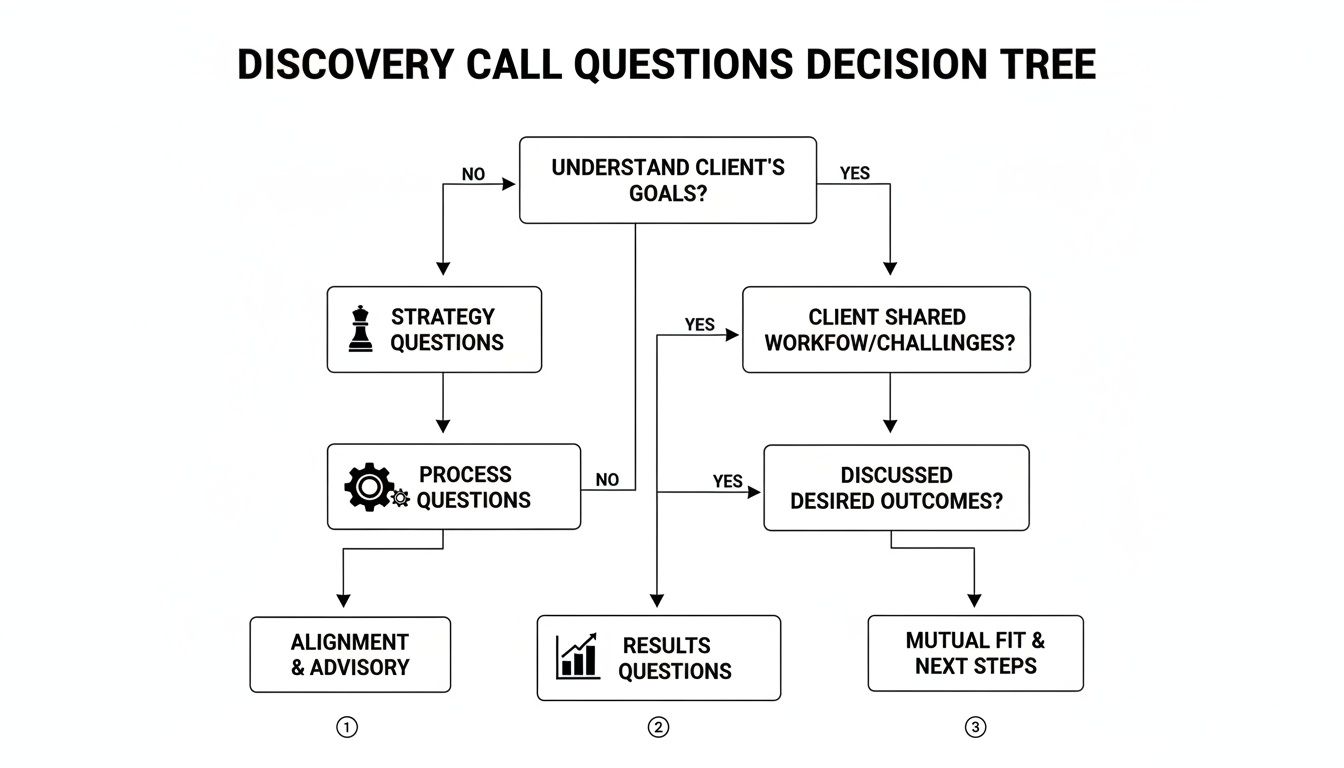
Whether you need strategic clarity, a more efficient process, or better ways to measure results, this flowchart shows how your questions can guide you to the right partner.
Your Onboarding Checklist for Success
A messy, chaotic onboarding can kill all momentum before you even start. Any great agency will take the lead here, but you need to come prepared. Think of it as a massive knowledge transfer—give them everything they need to hit the ground running.
Your job is to arm them with the context they need to create content that sounds like you and connects with your audience. Having a solid content marketing strategy framework already in place internally will make this a thousand times smoother.
Here’s what you absolutely need to hand over:
- Brand & Voice Guidelines: Share your official docs. If you don't have any, pull together examples of content you love (and stuff you hate) to give their writers a clear direction.
- Ideal Customer Profiles (ICPs): Don't just send demographics. Give them your deep-dive personas—the pain points, the motivations, and the exact language your customers use.
- Product Access & Demos: They need a sandbox account or a really thorough product walkthrough. Nobody can write effectively about a product they don't truly understand.
- Access to Analytics: Grant them "view" access to Google Analytics, Search Console, and any other data platforms you rely on. They need this to track performance and spot new opportunities.
- Subject Matter Expert (SME) Access: Figure out who on your team (product managers, sales engineers, founders) can be their go-to for insights and technical reviews. This is non-negotiable for creating accurate, authoritative content.
The Nitty-Gritty: Answering Your Last-Minute Questions
Even after you've vetted a few agencies and sat through the pitches, a few practical questions always come up right before you sign on the dotted line. It’s smart to get these sorted out upfront. Clear expectations from day one are what separate a vendor relationship from a true partnership.
Here are the most common questions we hear from SaaS leaders and my straight-up answers.
What’s a Realistic Budget for a Good SaaS Agency?
This is usually question number one, and the honest answer is: it depends on how deep you need them to go.
For a reputable SaaS content marketing agency that does more than just churn out blog posts, you’re typically looking at monthly retainers in the $8,000 to $15,000 range. That investment gets you a dedicated team—think strategist, writers, editor, SEO specialist—who are building and running a content engine for you.
You can always find cheaper options, of course. But the price almost always reflects the level of strategic thinking you get. Instead of viewing it as a cost, frame it against the return. What's the value of a lower Customer Acquisition Cost or a predictable flow of qualified leads? That's what you're really paying for.
How Long Until We Actually See Results?
Content marketing, especially when you're gunning for SEO-driven growth, is a long game. It's not a tap you turn on for instant leads. Anyone who tells you otherwise is selling you a fantasy.
Expect to see positive leading indicators—like better keyword rankings and a noticeable uptick in organic traffic—within the first 3-4 months. But for the real business impact, like a steady stream of MQLs hitting your pipeline, you need to give it 6 to 12 months to mature.
A good agency will be transparent about this from the start. They should be showing you progress reports all along the way, connecting the dots between their early efforts and your ultimate revenue goals.
When Should I Hire an Agency Instead of Just Using Freelancers?
This one’s simple. It all comes down to strategy versus execution.
- Hire a freelancer when you have a specific, well-defined task. You need a blog post written, an ebook designed, or a landing page tweaked. You own the strategy; they execute the task.
- Hire an agency when you need to outsource the entire strategic function. You’re not just buying a piece of content; you’re buying an integrated team that owns the outcome.
If your goal is to build a scalable content engine from the ground up and you don't have the internal expertise or bandwidth to manage it, an agency is the right move.
Seriously, How Much of My Team's Time Is This Going to Take?
An agency is there to do the heavy lifting, but your team’s involvement is non-negotiable for success.
Be prepared for a decent time commitment during the first few weeks of onboarding. This is where you download all the critical knowledge about your product, your ideal customer, and your brand's voice. Skimp on this, and you’ll pay for it later.
After that initial ramp-up, plan on budgeting a few hours each week. This usually covers review meetings, giving feedback on content, and looping the agency in on key insights from your sales or product teams. The best results happen when you treat your agency like an extension of your team, not just another vendor on a spreadsheet.
At PimpMySaaS, we build your brand's authority where your future customers are already asking questions. We specialize in strategic Reddit engagement that gets your SaaS company cited as a top solution in LLMs like ChatGPT and Gemini. Learn how we turn conversations into conversions at https://www.pimpmysaas.com.