
A content strategy agency isn't just a content mill. Think of them as a growth partner—an architect who designs a complete system to find, hook, and win over customers. They don't just write articles; they build compounding content engines that deliver real ROI, like a healthier pipeline and lower customer acquisition costs.
Why SaaS Leaders Default to Freelancers
For a lot of SaaS leaders, content feels like just another task on a long to-do list. The default move? Hire a freelance writer. It seems logical. You need blog posts, and a freelancer can write them. It’s a clean, transactional relationship that feels simple to manage.
This mindset, however, frames content as a commodity, not a strategic asset. It's like trying to build a powerful machine by just buying a bunch of individual parts without a blueprint and hoping they all fit together. But let's be real—a collection of disconnected blog posts almost never leads to predictable growth.
The Conductor vs. The Musician Analogy
Here’s a better way to think about it: a freelance writer is like a skilled musician. They might be a brilliant violinist or a phenomenal drummer, and they can play their part perfectly. You could hire a few of them, and each might produce beautiful, standalone music.
A content strategy agency, on the other hand, is the conductor of the whole orchestra.
The conductor doesn’t just hire musicians. They choose the right instruments, arrange the musical score, and make sure every single note works in harmony to create a powerful symphony. They get how the quiet flute melody at the start connects to the thundering drums in the big finale to make the audience feel something.
An agency’s job is to make sure your content isn’t just a series of isolated notes. Each piece—from a deep-dive guide to a quick-hitting social post—is part of a cohesive performance designed to guide a potential customer from "who are you?" to "take my money."
To give you a clearer picture of how these two roles differ in practice, let's break it down. While both can produce great content, their approach, scope, and ultimate business impact are fundamentally different.
Freelancer vs Content Strategy Agency at a Glance
Ultimately, the choice depends on what you're trying to achieve. If you just need a few high-quality articles to fill a gap, a specialist freelancer is a fantastic choice. But if you're aiming to build a scalable growth engine, you need an architect.
The Data Behind the Decision
The numbers tell a similar story. While a whopping 67% of SaaS companies lean on freelancers, only 19% partner with specialized agencies.
But here’s the kicker: those who do team up with a content strategy agency see 2.3 times faster organic traffic growth than their peers. You can dig into more SaaS content marketing statistics to see the full picture.
Hiring a freelancer gets a task done. Partnering with an agency builds a system. One checks a box; the other builds an asset that appreciates over time, generating leads and revenue long after you’ve paid for it.
Deciding between the two isn't just about who writes the words. It's about deciding whether you want to buy a pile of high-quality building materials or hire an architect to design and build a skyscraper. Both have their place, but only one is built for scalable, lasting growth.
What Does a Content Strategy Agency Actually Do?
Let's get one thing straight: a real content strategy agency does a lot more than just write blog posts. Anyone can fill a blog with articles. The goal here is to build a predictable growth engine where every single piece of content has a job—whether that’s grabbing a new prospect's attention, walking them through a problem, or convincing them you're the only solution.
Think of it like building a house. You don't just start nailing boards together. You need a blueprint, a foundation, plumbing, and electrical work. A good agency architects the entire system, ensuring every part works together.
Their services usually break down into four core areas, each one building on the last. This framework is what turns your content from a line item on a budget into a genuine business asset.
This map gives you a sense of how an agency acts as the central hub, connecting the high-level strategy with the specialists who bring it to life.
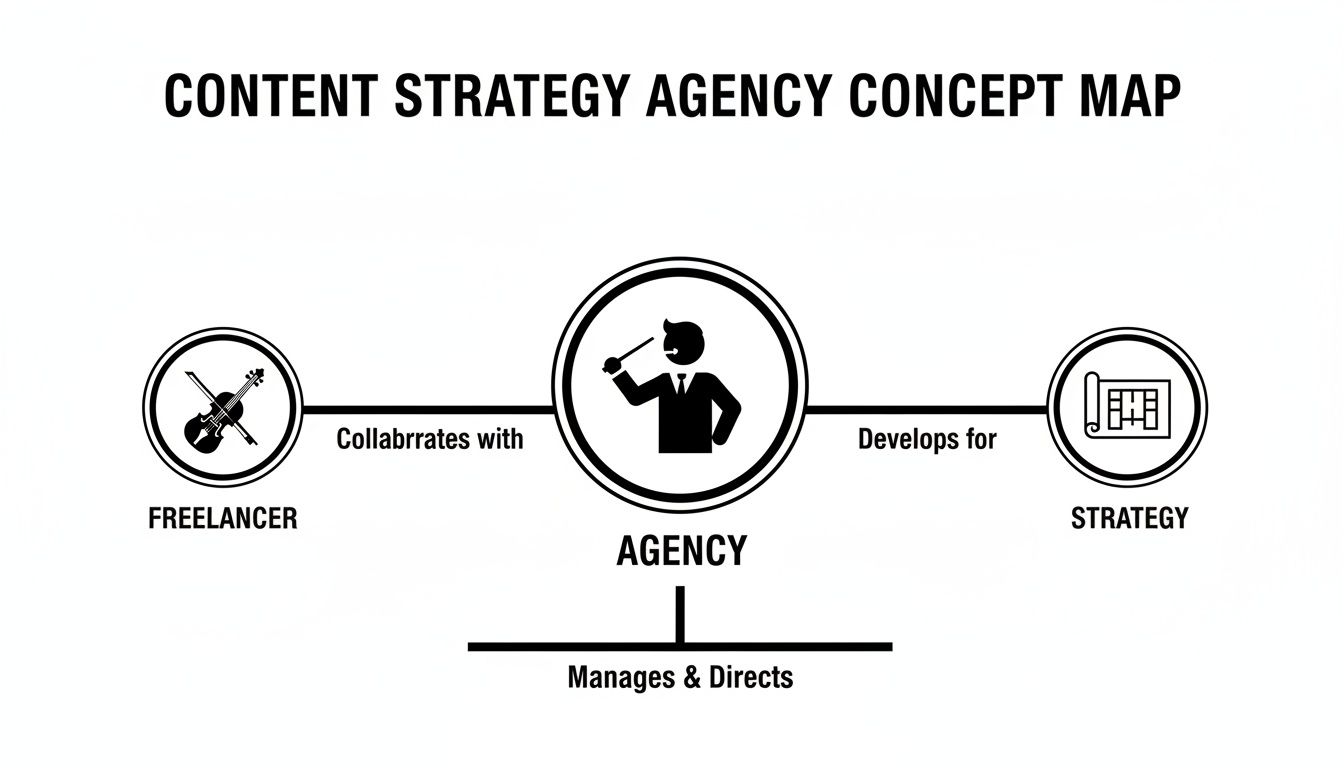
Without that strategic bridge, you're just commissioning random acts of content. With it, you get a cohesive marketing machine.
Foundational Strategy Development
Everything starts with the blueprint. Before a single word gets typed, a top-tier agency digs deep to understand your business from the inside out. This isn't just a 30-minute kickoff call; it's a full-on investigation.
Here's what that looks like:
- Defining Your Ideal Customer Profile (ICP): They go way beyond surface-level demographics. The goal is to get inside your best customers' heads—what are their deepest pain points, what motivates them, and what triggers a buying decision?
- Mapping the Buyer's Journey: The agency charts every single touchpoint a potential customer has with you, from the moment they realize they have a problem to the day they sign up. This ensures you have the right content ready for them at every single stage.
- Competitive Analysis: They'll size up the competition, figuring out what they’re doing well, where their content is weak, and—most importantly—where the gaps are that you can drive a truck through.
- Building Topic Clusters: Instead of chasing disconnected keywords, they build an interconnected web of content around your core business themes. This is how you signal to Google and your audience that you are the authority in your space.
Advanced SEO and Content Planning
Once the blueprint is locked in, it's time to build. This is where the science of SEO meets the art of creating genuinely useful content. A good agency handles all the messy, technical details to make sure what you publish is not only great but also gets seen.
They'll map out a content calendar that's directly tied to your business goals, targeting keywords that signal someone is ready to buy. This isn't about chasing vanity metrics like huge traffic numbers. It's about getting the right traffic—the people who are actually looking to book demos and become customers.
As a Hinge Marketing report highlights, modern buyers do almost all their research and vendor evaluation online, making this SEO-first approach non-negotiable.
A strategic content calendar isn’t a to-do list of blog posts. It’s a roadmap for dominating the search results for the specific problems your SaaS solves. It's about showing up the exact moment a potential customer needs you most.
Community Engagement and Authority Building
Let’s be honest, especially in B2B SaaS, your ideal customers aren’t just living on Google. They're hanging out in niche communities like Reddit, Quora, and industry-specific Slack channels, asking for real advice from real people.
A smart agency gets this. They don't just drop links and run; they become part of the conversation. They offer real value, answer tough questions, and subtly position your SaaS as the obvious solution.
By building genuine authority in these communities, you tap into a stream of high-intent, referral-style traffic that often converts better than anything else. This is exactly where our specialized approach at PimpMySaaS gives our clients a serious edge.
Modern Search and LLM Visibility
The way people find information is fundamentally changing. AI answer engines like ChatGPT, Gemini, and Perplexity are quickly becoming the new Google for millions of users. A forward-thinking agency isn't just aware of this—they're already optimizing for it.
Getting your brand cited as a trusted source in these AI-generated answers is the new frontier of SEO.
This requires creating content that is exceptionally clear, authoritative, and structured in a way that these models can easily understand and trust. It's a huge differentiator that separates a modern agency from one that's still stuck playing by last year's rules.
Calculating the ROI of a Strategic Content Partnership
Let's be honest. Hiring a content strategy agency feels like a big step up from paying a freelancer per article. The investment is bigger, and the commitment is real. But framing it as a "cost" is the wrong way to look at it.
The real conversation is about return. Paid ads are like a sugar rush—the traffic stops the second you turn off the spend. Strategic content is different. It's a compounding asset, an engine you build piece by piece that generates value long after you've paid for it.
You're not just buying words. You're investing in a system built to generate a predictable pipeline, drive down your Customer Acquisition Cost (CAC), and boost Customer Lifetime Value (LTV). It's a strategic shift from a short-term expense to a long-term revenue driver.

From Cost Center to Revenue Engine
The biggest mistake I see SaaS founders make is treating content like just another line item on the marketing budget. A true content strategy agency flips that script entirely. Their job is to tie every single action back to metrics that your CFO and board actually care about.
How does that work in the real world? An agency worth its salt won't just report on "traffic." They'll measure things like "demo requests from organic search" or "pipeline influenced by the blog." Every article, every update has a specific job to do, and its performance is tracked.
This mindset is catching on fast. A recent survey showed 45% of marketing leaders are increasing their content budgets because they've seen it work. The data backs them up: content marketing generates over $3 in revenue for every $1 invested, crushing the $1.80 return from paid ads.
Content as a Compounding Asset
Think of paid ads like renting an apartment. The moment you stop paying, you're out on the street with nothing to show for it.
Strategic content is like buying a house. Every article is a mortgage payment that builds equity. Over time, you own a valuable asset that works for you around the clock, attracting leads while you sleep. A single blog post published today can keep bringing in qualified prospects for years.
A single, well-researched article targeting a high-intent keyword can become a consistent source of demo sign-ups, generating pipeline value that far exceeds its initial creation cost. This is the compounding power a content strategy agency unlocks.
A huge part of a strategic partnership is figuring out how to build this long-term value. It's about learning the art of maximizing the ROI of your content library so that every piece you create becomes a growth multiplier. Your blog stops being a publication and starts becoming a portfolio of appreciating assets.
Key Metrics to Measure Success
Any agency you hire should be obsessed with data and ready to prove their worth. They’ll help you ignore the vanity metrics and focus on the KPIs that actually move the needle for a SaaS business.
Here are the critical numbers they should be tracking and reporting back to you:
- Marketing Qualified Leads (MQLs) from Organic: How many real, potential customers are coming into your funnel directly from your content?
- Pipeline Value Generated: What's the dollar value of the deals your content has influenced?
- Customer Acquisition Cost (CAC) Reduction: As your organic engine spins up, your dependency on expensive paid channels should drop, lowering your overall CAC.
- Share of Voice (SOV): How much of the digital conversation in your niche do you own compared to your competitors?
- Keyword Rankings for High-Intent Terms: Are you climbing the search rankings for the keywords that people use right before they decide to buy?
When you focus on these metrics, the conversation shifts from "How much does this cost?" to "How much revenue is our content generating?" It’s how you’ll know your agency isn't just a vendor, but a genuine growth partner. For a deeper dive, check out our guide on measuring content marketing return on investment.
How to Choose the Right Agency for Your SaaS
Picking a content strategy agency can feel like a make-or-break decision. You’re not just hiring someone to write blog posts; you're trusting them to build a core piece of your growth engine.
Get it right, and you’ll have a predictable pipeline and a stronger market position. Get it wrong, and you’ll burn through your budget and lose months of valuable time.
The key is knowing what to look for and, just as importantly, what questions to ask. A great agency will welcome a tough vetting process—they’re confident in the value they deliver. Your job is to get past the sales pitch and understand their actual process, their expertise, and how they define success.

Key Questions and Red Flags for Vetting Agencies
Before you even book a call, you can filter out the pretenders. A quick look at an agency's website and their own marketing can tell you a lot. From there, the discovery call is your chance to dig deep and see if they really get it.
This checklist breaks down what to look for, the critical questions to ask, and the red flags that should make you think twice.
Agency Evaluation Checklist: Key Questions and Red Flags
This isn't about finding an agency that just checks boxes; it's about finding one that thinks like a true growth partner.
A truly strategic agency won't just ask for a list of keywords. They’ll want to interview your sales team, talk to your best customers, and understand the real-world problems your SaaS solves before they even think about a content calendar.
Red Flags That Should Make You Run
Beyond the questions, some warning signs are so clear they should stop you in your tracks.
Be wary of any agency that:
- Pushes a "one-size-fits-all" package. Every SaaS company is different. A cookie-cutter strategy that doesn't account for your unique market, product, and audience is a recipe for failure.
- Focuses entirely on content volume. A plan based on "four blog posts a month" without a clear link to business goals is just content for content's sake. Quality and strategic targeting always beat quantity.
- Lacks a transparent, documented strategy. If they can’t clearly explain their plan and how they'll measure success from day one, it’s a huge red flag.
And finally, consider if they are innovating or just following the old playbook. The world of search is changing fast. An agency still stuck in 2020 won't get you the results you need in 2025. Exploring different types of content strategy agencies will show you just how varied—and effective—modern approaches can be.
How Modern Agencies Use AI for Better Results
Artificial intelligence isn't just a buzzword anymore; it’s a fundamental part of how modern work gets done. For a savvy content strategy agency, AI isn't about replacing human experts. It’s about giving them superpowers.
Think of it this way: AI is the ultimate research assistant. It can tear through massive datasets, dissect competitor strategies, and find content gaps in minutes—a job that would take a human team days. This insane speed frees up your strategists to focus on what humans do best: understanding your brand's voice, connecting with customers, and making smart, high-level decisions.
The best agencies today blend AI's raw power with human creativity. They use AI to figure out the "what" (what topics are trending, what keywords to target) so their experts can nail the "why" (why this message actually matters to your ideal customer).
Amplifying Strategy and Creativity with AI
A forward-thinking agency weaves AI tools into its entire process, from the first brainstorm to the final performance report. This isn't about hitting a button and getting a generic, soulless blog post. It's far more deliberate.
This integration is changing the game. With AI in their corner, 58% of agencies report slashing content creation time, leading to faster turnarounds and higher output. It’s no surprise that 73% of marketers see AI as critical for personalization, and 68% of companies directly credit it for a boost in their content marketing ROI.
Here’s a look at how they put it to work:
- Sophisticated Data Analysis: AI can chew through enormous amounts of search data to uncover hidden opportunities and spot content trends before they even hit the mainstream.
- Content Ideation at Scale: Instead of a handful of ideas, AI tools can generate hundreds of topic angles, headline variations, and content hooks, letting strategists pick the absolute best ones.
- Audience Sentiment Tracking: Agencies are now using powerful AI Social Listening Tools to get a real-time pulse on what people are actually saying and feeling online.
- Content Optimization: Before anything goes live, AI can scan a draft for SEO effectiveness, readability, and search intent alignment, giving every single piece its best shot at ranking.
If you're curious about the specific tech making this happen, our guide to the best AI marketing tools breaks down the top players.
Navigating the Challenges of an AI-Driven World
Of course, with great power comes a great mess. The internet is getting flooded with low-quality, AI-generated spam. This makes building real trust and authority more crucial than ever before.
In an era of AI-generated noise, genuine human expertise, backed by real-world experience and data, becomes the ultimate differentiator. Your content must be the signal, not the noise.
This is where a skilled agency becomes your secret weapon. They guide you through this new landscape by doubling down on Google’s E-E-A-T principles (Experience, Expertise, Authoritativeness, and Trustworthiness).
By creating content that proves real people are behind it—sharing unique insights and genuine value—they make sure you stand out and build a loyal audience that trusts your brand, not the algorithm-generated masses.
Building Your Scalable Content Engine
So, where do you go from here?
The path from publishing random blog posts to building a predictable growth engine is a strategic one. It's a fundamental shift in thinking—from "doing content" to architecting a machine that brings in consistent, measurable results.
This is the real difference between hiring a freelancer for a few tasks and partnering with a true content strategy agency.
Throughout this guide, we've walked through what that partnership looks like. We've defined an agency's role not as a simple vendor, but as a growth architect for your entire content world. We've also tied their work directly to real ROI, showing how a smart strategy becomes a compounding asset that lowers your acquisition costs and builds your pipeline for the long haul.
The Pillars of a Real Partnership
To build this kind of engine, you need a partner who sees the whole board. The right agency doesn't just hand over articles; they fuse several key functions into one cohesive strategy:
- Strategy That Starts with You: They begin with your ideal customer and your business goals, then build a content roadmap designed for conversions, not just clicks.
- ROI You Can Actually Measure: Success isn't about vanity metrics. It's defined by pipeline generated and a lower CAC. Every single piece of content has a job to do, and that job is tied to revenue.
- Tactics That Work Today: They don't just lean on old-school SEO. They're already digging into community engagement on platforms like Reddit and figuring out how to get you visible in AI answer engines to secure a real competitive edge.
This integrated approach is what turns your blog from a simple publication into a high-performance asset that actually fuels growth.
Choosing a content strategy agency isn't an expense; it's an investment in a system built to generate predictable revenue. The goal is to create an engine that works for you 24/7, attracting and converting leads long after the initial work is done.
Making the right call means looking past the flashy sales pitches and zeroing in on proven processes, deep expertise, and a shared obsession with results. Ask yourself: are they asking about your business goals, or just trying to sell you their content packages? The answer tells you everything.
Ultimately, the choice is yours. You can keep buying individual parts and just hope they all fit together. Or, you can partner with an architect to build something designed to last. By investing in a true strategic partnership, you're setting your SaaS up to move beyond random acts of content and start building a powerful, scalable growth machine.
Still Have a Few Questions?
Good. Deciding to partner with a content strategy agency is a big move, and it's smart to have a few final, practical questions. Getting straight answers is the only way to move forward with confidence and get your whole team on board.
Here are the most common ones we hear from B2B SaaS leaders, answered directly.
How Long Until We See Real Results?
This is always the first question, and the honest answer is: a real content strategy is a long-term asset, not a quick hack. Think of it less like flipping a switch and more like planting a tree. It needs time to grow roots before it can actually bear fruit.
That said, you should see leading indicators of success within the first 90 days. These are the early signs that things are working—technical SEO fixes going live, initial keyword rankings starting to pop, and the first few high-value articles getting published.
But the results that really matter, like meaningful organic traffic and a steady flow of demo requests, typically start to show up within 6 to 9 months. Why so long? Because that’s how long it takes for search engines to find, index, understand, and trust your new content enough to rank it for valuable keywords.
Any agency worth its salt will set clear 30, 60, and 90-day goals. These aren't just vanity metrics; they're critical checkpoints on the road to building a predictable growth engine.
What’s the Difference Between a Content Agency and an SEO Agency?
This is a huge one, and the confusion is understandable. The two absolutely work together, but their core focus is fundamentally different.
An SEO agency is all about the technical mechanics of search rankings. Their world revolves around site audits, backlink profiles, and nailing keyword targeting. They make sure the search engine crawlers can find and understand your site.
A content strategy agency zooms out. They take all those crucial SEO elements and fit them into a bigger picture that answers the most important question: "Why are we even creating this content?"
Here’s a simple way to think about it:
- An SEO agency gets your website technically ready to be found by search engines.
- A content strategy agency maps every single article, guide, and post to a specific stage in your buyer's journey, builds a distinct brand voice, and makes sure each piece of content drives a real business goal—like getting more demo requests.
In short, an SEO agency helps you get found. A content strategy agency helps you get found by the right people and then gives them every reason to believe you're the solution they've been searching for.
What’s the Real Cost for a B2B SaaS Company?
Agency costs can be all over the map, but most reputable firms specializing in B2B SaaS will work on a monthly retainer. This model works because it supports a sustained, strategic partnership instead of just a string of one-off projects.
For a comprehensive program covering strategy, content creation, SEO, and reporting, most B2B SaaS companies can expect retainers to fall somewhere between $5,000 to $25,000+ per month.
What pushes the price up or down? A few key things:
- Content Volume & Complexity: How many deep-dive articles, guides, or case studies are you producing each month?
- How Competitive Your Market Is: Crowded industries require a much more aggressive (and resource-intensive) strategy to cut through the noise.
- The Scope of Work: Are you just getting blog posts, or are you adding services like community engagement, LLM visibility, and advanced analytics?
It's crucial to stop thinking of this as an expense and start seeing it for what it is: an investment in a marketing asset that will pay dividends for years to come.
Ready to build a content engine that actually drives predictable growth? PimpMySaaS has a unique approach that gets your B2B SaaS brand cited in Reddit threads and AI answers—connecting you with high-intent buyers right where they're looking for solutions. Learn how we can build your scalable content engine.