In the crowded B2B SaaS landscape, authentic trust is the ultimate currency. While traditional marketing shouts, User-Generated Content (UGC) builds genuine connections and credibility. UGC, which is any content created by your actual users, serves as powerful social proof, validating your product's value in a way no branded message ever could.
For SaaS companies, especially those aiming to increase visibility in AI-powered search results, a robust set of user generated content strategies is no longer optional; it's essential for survival and growth. Think of it as empowering your happiest customers to become your most effective marketers. Raw, unfiltered feedback and organic conversations on platforms like Reddit are goldmines for this, shaping perceptions and directly influencing purchasing decisions long before a prospect visits your website.
This article breaks down 10 potent user generated content strategies, tailored specifically for the B2B SaaS ecosystem. We will move beyond the basics, offering a practical playbook for each strategy. You will find step-by-step implementation guides, Reddit-specific tactics to amplify your efforts, and the key metrics you need to track to prove ROI. Get ready to transform your users from passive subscribers into an active, content-generating community that drives measurable growth.
1. Customer Review and Testimonial Campaigns
This foundational strategy focuses on systematically collecting, curating, and amplifying authentic customer feedback. These peer recommendations, ranging from short reviews to in-depth case studies, serve as powerful social proof that builds trust with prospects far more effectively than branded content alone.
Why It Works for B2B SaaS
In B2B, purchasing decisions involve high stakes and multiple stakeholders. Testimonials and reviews de-risk the decision-making process by providing an unbiased, third-party perspective on your product's real-world value, reliability, and ROI. They answer the critical question every prospect has: "Will this actually work for a company like mine?" This type of social proof is a cornerstone of effective user generated content strategies.
Step-by-Step Implementation
- Identify Optimal Moments: Trigger review requests at key points in the customer lifecycle, such as after a successful onboarding, a positive customer support interaction, or when a user achieves a specific milestone within your app.
- Automate the Ask: Use email marketing automation or in-app prompts to ask for feedback. Frame the request around their experience, not just your need for a review.
- Short Quotes: Ideal for landing pages and ad copy.
- Video Testimonials: Highly engaging for your homepage or case study pages.
- Third-Party Reviews: Direct customers to platforms like G2, Capterra, and TrustRadius.
- Amplify and Repurpose: Feature the best reviews on your website, share them on social media, and incorporate them into sales decks and email nurture sequences.
- Choose the Right Platform: Select a platform that fits your audience. A dedicated forum (e.g., Discourse, Insided) is great for searchable, long-form content, while Slack or Discord excels at real-time interaction and relationship-building.
- Seed Initial Content and Engagement: Don't launch to an empty room. Have your team post common questions, tutorials, and conversation starters. Actively moderate and participate to set a positive and helpful tone.
- Establish Clear Guidelines: Create and enforce community rules to ensure discussions remain respectful, on-topic, and free of spam. A well-moderated space encourages higher-quality participation.
- Empower Super Users: Identify and reward your most active and helpful community members. Give them special titles, early access to features, or other perks to encourage their continued contributions.
- Identify Strategic Partners: Look beyond follower counts. Prioritize partners whose audience demographics and professional expertise perfectly align with your ideal customer profile. This could be a respected consultant, a power user with a strong LinkedIn presence, or a micro-influencer in a specific vertical.
- Co-created Content: Partner on a webinar, a joint whitepaper, or a video series where the influencer provides their unique insights.
- Guest Blogging: Invite industry experts to write for your blog, offering them a platform in exchange for their valuable perspective.
- Social Takeovers: Allow a trusted partner to run your Instagram Stories, Twitter account, or LinkedIn for a day, often centered around an event or a specific "day in the life" theme.
- Establish Clear Guidelines & Goals: Provide your partner with a creative brief that outlines key messages, goals, and brand guidelines, but grant them the creative freedom to speak in their authentic voice. Overly scripted content will fail.
- Promote and Amplify: Promote the collaboration across all your channels before, during, and after the event. Treat the co-created asset or takeover as a mini-campaign to maximize its reach and impact.
- Define a Clear Use Case: Decide what you want to showcase. For a project management tool, this could be "Show us your most organized project dashboard." For a design tool, it might be "Share your favorite creation."
- Simplify the Submission Process: Create a simple, mobile-friendly submission form on your website or run a campaign using a dedicated hashtag on social media. The fewer steps required, the higher the participation rate.
- Offer Incentives for Quality: Encourage high-quality submissions by offering incentives like a feature on your homepage, a shout-out on social media, or a small discount. Clearly communicate submission guidelines to ensure content meets your standards.
- Curate and Showcase: Build a visually appealing gallery on your website. Tag, categorize, and feature the best submissions prominently across marketing channels, including in blog posts, email newsletters, and sales presentations.
- Define a Clear Objective: Determine the goal. Is it to highlight a new feature, gather diverse templates, or simply increase brand engagement? The goal will shape the contest rules and theme.
- Establish Simple Rules and Attractive Incentives: Make participation easy. The barrier to entry should be low, but the incentive must be valuable to your audience, like premium feature access, a significant discount, or professional recognition.
- Promote Across All Channels: Announce the contest through email newsletters, social media, in-app notifications, and your community forum. Use countdowns to create a sense of urgency.
- Showcase and Celebrate Entries: Feature submissions in real-time on a dedicated landing page or social media feed. Prominently celebrate the winner(s) across all channels, explaining why their entry was chosen to provide value to all participants.
- Choose the Right Platform: Select a platform that fits your audience's habits. Options range from dedicated software like Circle or Mighty Networks to more integrated solutions like Slack or even a subreddit.
- Seed Initial Content: Don't launch an empty forum. Pre-populate it with FAQs, "Getting Started" guides, and conversation prompts to encourage early engagement and set the tone.
- Establish Clear Guidelines: Create and enforce community guidelines to ensure discussions remain respectful, on-topic, and productive. A well-moderated space is crucial for long-term health.
- Empower Superusers: Identify and empower your most active and helpful members. Create ambassador programs or special roles to recognize their contributions and encourage them to help guide the community.
- Establish Clear Guidelines: Create a simple social media policy that empowers rather than restricts. Outline brand voice principles and legal dos and don'ts, but encourage personal expression and authenticity.
- Provide Resources and Prompts: Don't leave employees guessing. Supply them with a content repository containing shareable blog posts, industry news, and company updates. Offer prompts like "Share a recent project win" or "What's one thing you've learned this week?"
- Make Sharing Easy: Implement an advocacy tool (like GaggleAMP or EveryoneSocial) that allows employees to share pre-approved content with a single click across their social networks.
- Recognize and Reward: Acknowledge top contributors publicly through internal communications or company-wide meetings. Consider a small incentive program, such as gift cards or extra PTO, to gamify participation and show appreciation.
- Identify and Recruit Power Users: Pinpoint your most active and proficient users through product analytics or community engagement. Reach out to them personally and invite them to become content creators.
- Provide Resources and Incentives: Offer users a "creator kit" with brand assets, video templates, and style guides. Incentivize participation with rewards like free premium features, gift cards, or public recognition on your blog and social channels.
- Create a Centralized Hub: Build a dedicated section on your website or help center to host user-created tutorials. Organize content with tags by feature, use case, or skill level to make it easily discoverable.
- Promote and Feature Top Content: Regularly feature the best user-generated tutorials in your newsletters, social media feeds, and onboarding sequences. This not only provides value to other users but also rewards the creators and encourages more submissions.
- Identify Ideal Candidates: Look for customers who have achieved significant, measurable results, represent your ideal customer profile, or have a compelling transformation story. Your customer success team is the best source for identifying these advocates.
- Standardize Your Process: Create a clear case study template and interview structure. This ensures you consistently capture key information like the initial challenge, the decision-making process, and, most importantly, specific metrics demonstrating impact (e.g., "35% increase in team productivity").
- Written Case Study: Create a detailed PDF for your sales team and a web version for your site.
- Video Story: Film a high-quality video interview for maximum engagement on your homepage and social channels.
- Quote Snippets: Extract powerful customer quotes for use in ad copy, landing pages, and social media graphics.
- Promote Strategically: Distribute your finished case studies across all relevant channels. Feature them prominently on your website, share them on LinkedIn, equip your sales team with them, and use them in targeted email campaigns.
- Define the Value Proposition: Clearly articulate what members gain. Will it be exclusive access to product managers, early access to new features, premium content, or peer networking opportunities? The value must be compelling.
- Start with an Engaged Core: Invite your most passionate early adopters and power users first. This "founding member" group will set the tone and help build initial momentum.
- Host Exclusive Events: Run member-only webinars, AMAs (Ask Me Anything) with your leadership team, or virtual workshops.
- Promote Member Contributions: Create dedicated channels for users to share their work, showcase their successes, and get feedback from peers.
- Implement Recognition: Use badges, leaderboards, or "member of the month" spotlights to reward active participants and gamify the experience.
- Solicit and Act on Feedback: Make community feedback a central part of your product roadmap. Visibly implementing member suggestions shows you are listening and builds immense loyalty.
- Start with Your Goals: Are you aiming for increased social proof, deeper community engagement, or a richer content library for your sales team? Align your chosen UGC strategy directly with a core business objective. A company seeking to improve onboarding might prioritize user-generated tutorials, while one focused on top-of-funnel awareness could launch a targeted hashtag campaign.
- Lower the Barrier to Entry: Make participation as effortless as possible. For photo or video contests, provide clear, simple prompts. For testimonials, offer a structured form or a one-click recording tool. The easier you make it for users to contribute, the more content you will receive.
- Empower, Don't Control: The magic of user generated content is its raw, unfiltered nature. While you must set clear guidelines and moderate for quality and appropriateness, avoid overly restrictive rules that stifle creativity. Give your users the framework and let their genuine experiences shine through.
- Measure What Matters: Success isn't just about the volume of content. Track metrics that tie back to your goals. For a review campaign, this might be the impact on conversion rates. For a community forum, it could be a reduction in support tickets or an increase in product feature adoption. This data will prove the ROI of your user generated content strategies and guide future efforts.
Pro-Tip: Respond to every review, both positive and negative. Engaging with criticism shows you value feedback and are committed to improvement, which is a crucial part of your overall online reputation management. To explore this further, you can learn more about building a strong online reputation management guide.
2. Community-Driven Content and Forums
This strategy involves creating or nurturing a dedicated space where users can interact, share knowledge, and solve problems together. This hub, often a company-hosted forum or an active Slack/Discord community, becomes a self-sustaining engine for user generated content, from simple Q&As to complex, user-created tutorials and guides.
Why It Works for B2B SaaS
B2B SaaS products often have a steep learning curve and diverse use cases. A community forum decentralizes support, allowing expert users to help new ones, which reduces the burden on your official support channels. It also provides invaluable, direct insight into how customers use your product, what features they desire, and the specific challenges they face, making it a goldmine for product development and one of the most organic user generated content strategies.
Step-by-Step Implementation
Pro-Tip: Actively listen to your community to identify emerging trends, feature requests, and common pain points. This direct feedback loop is crucial for product innovation and customer retention. For deeper insights into cultivating active user communities and fostering vibrant discussions, explore these resources on community engagement best practices.
3. Influencer Collaboration, Content Co-Creation, and Social Takeovers
This strategy moves beyond passively collecting UGC by actively partnering with influential figures, industry experts, or even power users to create content. It combines the authenticity of a trusted third-party voice with the reach of a brand's platform through co-created assets, guest posts, and dynamic social media "takeover" events.
Why It Works for B2B SaaS
B2B SaaS operates in a world of niche expertise. Partnering with a respected industry influencer or an expert guest lends your brand immediate credibility and authority. Their endorsement or co-created content acts as a powerful shortcut to building trust with a highly specific, relevant audience. Takeovers provide a fresh perspective, breaking the monotony of typical brand content and showcasing your product's value from a new angle.
Step-by-Step Implementation
Pro-Tip: Focus on building long-term relationships rather than one-off transactions. An ongoing partnership with a key influencer can evolve into a brand ambassadorship, creating a consistent and powerful stream of authentic content that resonates deeply with your target audience.
4. User-Submitted Photo and Video Galleries
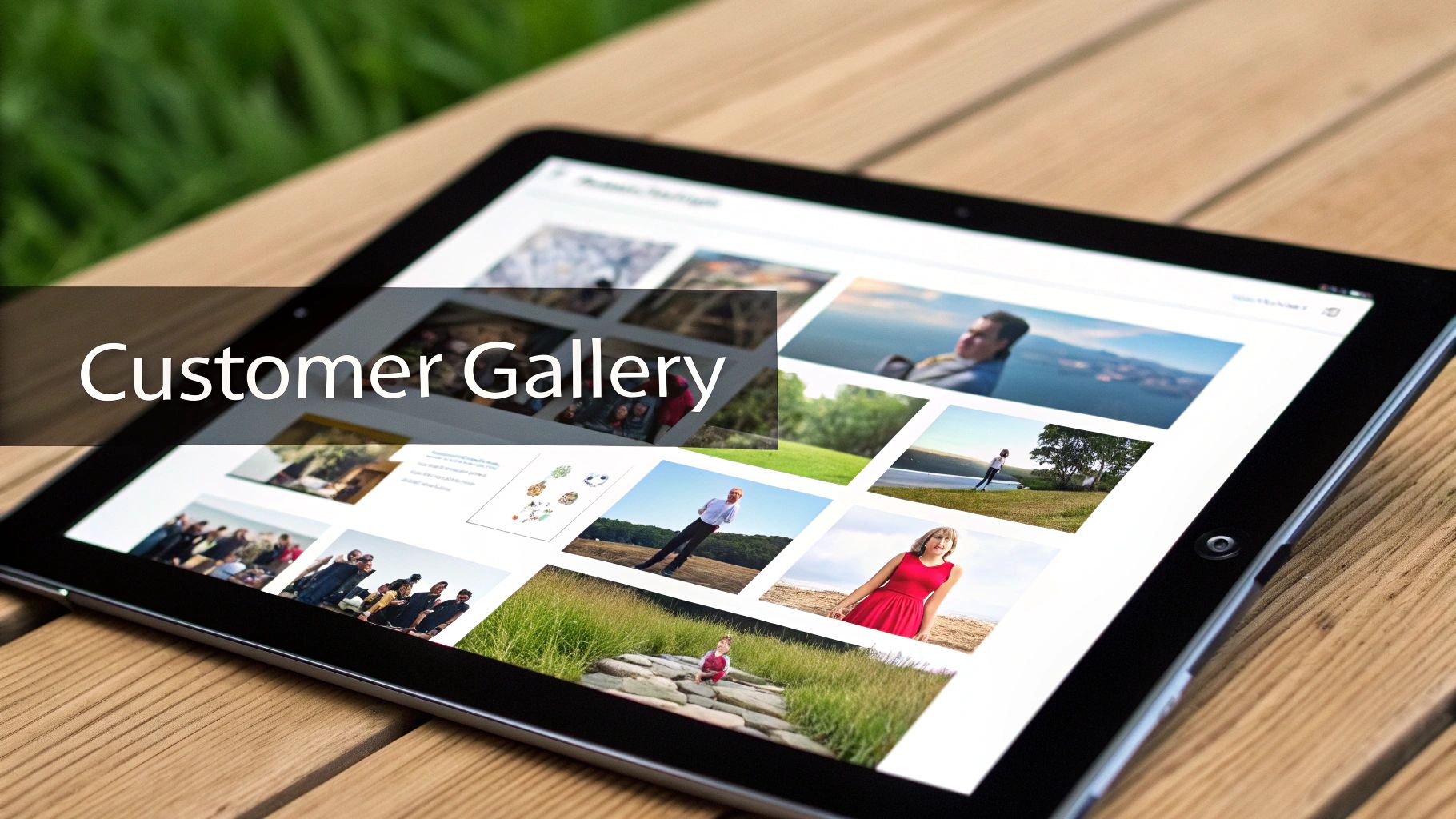
This strategy involves creating dedicated galleries or sections on your website and social platforms to showcase authentic photos and videos submitted by users. This visual content demonstrates your SaaS product in action within real-world business environments, moving beyond polished marketing assets to provide tangible, relatable proof of its application and value.
Why It Works for B2B SaaS
In B2B SaaS, visualizing the product's impact can be challenging. A gallery of user-submitted screenshots, screen recordings, or dashboard setups helps prospects see how others are successfully using your software to solve problems similar to their own. It brings abstract features to life, showing custom reports, complex workflows, or team collaboration in a way that feels authentic and attainable. This visual social proof is a powerful component of modern user generated content strategies.
Step-by-Step Implementation
Pro-Tip: Always secure explicit permission to use submitted content for marketing purposes. Include a checkbox on your submission form where users agree to your terms of use. Clearly crediting the user or their company builds goodwill and encourages more submissions.
5. Community-Driven Content Challenges and Contests
This gamified strategy invites your user base to participate in creative challenges or competitions centered around your product. By setting a specific theme, such as "show us your most innovative workflow" or "design the most effective dashboard," you can generate a high volume of diverse and practical content while fostering community engagement and friendly competition.

Why It Works for B2B SaaS
Contests transform passive users into active creators and advocates. For B2B SaaS, this approach uncovers novel use cases and workflows that your own marketing team might never have discovered. It showcases your product's flexibility and power through the lens of your most advanced users, creating authentic, aspirational content that educates prospects on what's possible. These campaigns are excellent user generated content strategies for boosting engagement and building a vibrant user community.
Step-by-Step Implementation
Pro-Tip: Extend the life of your contest by repurposing the winning content and other high-quality submissions. Turn the best entries into a webinar, a blog post detailing "10 Creative Ways to Use [Your Product]," or a downloadable template library for new users. This maximizes the ROI of the initial campaign.
6. Community Forums and Discussion Boards
This strategy involves creating a dedicated online space where customers can connect, share tips, ask questions, and support one another. These platforms, from traditional forums to modern Slack or Circle communities, become self-sustaining engines of authentic content, generating everything from troubleshooting threads to user-created tutorials and best-practice guides.
Why It Works for B2B SaaS
B2B software is often complex, with a steep learning curve. A community forum transforms your most knowledgeable users into a volunteer support and success team. It provides a scalable way for customers to get answers, discover advanced use cases, and feel a sense of belonging. This peer-to-peer interaction builds deep product loyalty and provides your team with a direct, unfiltered channel for customer feedback and product ideas, making it one of the most valuable user generated content strategies.
Step-by-Step Implementation
Pro-Tip: Your brand's role is to be a facilitator, not a constant salesperson. Participate actively by answering tough questions, celebrating user-created solutions, and showing that you're listening to feedback. Mastering these interactions is key. You can discover more by reading about community engagement best practices.
7. Employee Advocacy and Staff-Generated Content
This strategy transforms your employees into powerful brand ambassadors, encouraging them to create and share authentic content about their work, expertise, and company culture. Employee-generated content (EGC) leverages the trust inherent in personal networks, distributing your brand message with a credibility that corporate channels often lack.
Why It Works for B2B SaaS
In B2B SaaS, expertise and culture are key differentiators. When your engineers, product managers, or sales leaders share insights, they are not just promoting a product; they are showcasing the human intelligence and vibrant culture powering it. This approach builds brand trust from the inside out and helps attract both top-tier talent and customers who resonate with your company's values. EGC is a highly effective, yet often overlooked, component of modern user generated content strategies.
Step-by-Step Implementation
Pro-Tip: Focus on making participation voluntary and fun. Mandated advocacy feels forced and inauthentic. Instead, build an internal culture where employees are genuinely proud and excited to share their experiences and the great work their teams are doing.
8. User-Generated Tutorials and How-To Content
This strategy involves empowering your expert users to create and share their own tutorials, guides, and how-to videos. It transforms your most knowledgeable customers into educators, creating a scalable library of practical, peer-to-peer learning content that demonstrates your product's real-world applications and creative uses.
Why It Works for B2B SaaS
In B2B SaaS, products often have deep feature sets and steep learning curves. User-generated tutorials address this by providing authentic, use-case-specific guidance that official documentation might miss. This content builds a community of expertise, reduces the burden on your support team, and showcases the product's versatility through the eyes of those who know it best. It’s a powerful form of user generated content strategies that also fosters a highly engaged power-user base.
Step-by-Step Implementation
Pro-Tip: Don't expect perfection. The value of user-generated tutorials lies in their authenticity and relatability, not in high production quality. Encourage creators to focus on clear, practical explanations that solve a specific problem for their peers.
9. Customer Story and Case Study Marketing
This strategy elevates simple testimonials into detailed, data-backed narratives of customer success. Case studies and customer stories document the journey a client took with your product, from the initial problem to the achieved solution, providing persuasive evidence of your value proposition through real-world application and measurable results.
Why It Works for B2B SaaS
High-consideration B2B purchases demand robust proof of ROI. Detailed case studies serve as a blueprint for success that prospects can see themselves in. By outlining the specific challenges, implementation process, and quantifiable outcomes, you give decision-makers the concrete data and compelling narrative they need to build an internal business case for your solution. This is a cornerstone of sophisticated user generated content strategies.
Step-by-Step Implementation
Pro-Tip: Always use the customer's own words whenever possible. Direct quotes are more authentic and relatable than marketing-speak. Frame the story around their journey and their success, making them the hero, with your product serving as the essential tool that enabled their victory.
10. Branded User Communities and Membership Programs
This advanced strategy involves creating an exclusive space, either free or paid, where your most loyal customers can connect, share insights, and access premium resources. These structured communities transform passive users into active brand advocates and co-creators, generating high-quality, targeted content that resonates deeply with your ideal customer profile.
Why It Works for B2B SaaS
In the B2B world, fostering a sense of belonging and professional development is a powerful retention tool. A branded community provides a dedicated forum for users to network, troubleshoot complex issues, and share best practices, which deepens their investment in your ecosystem. This not only generates authentic content but also creates a valuable feedback loop for product development and solidifies your brand's position as a thought leader. This makes it one of the most powerful long-term user generated content strategies.
Step-by-Step Implementation
Pro-Tip: The success of a community hinges on its structure and moderation. Don't leave engagement to chance. For comprehensive guidance on how to build an online community that truly fosters engagement and drives user-generated content, consult this definitive guide to building an online community.
10-Point UGC Strategy Comparison
Putting It All Together: Your Next Steps in UGC Mastery
We've explored a comprehensive landscape of ten powerful user generated content strategies, moving from the dynamic engagement of hashtag campaigns and community contests to the foundational trust built by customer testimonials and in-depth case studies. Each approach, from leveraging employee advocacy to fostering vibrant community forums, offers a unique pathway for B2B SaaS companies to transform passive users into active brand champions. The common thread weaving through all these tactics is authenticity. Your most compelling marketing assets are not crafted in a boardroom; they are created daily by the people who use, value, and innovate with your product.
The journey to an effective UGC program is not about implementing all ten strategies at once. Instead, it's a strategic process of selection and focused execution. The true challenge lies in shifting from a mindset of content creation to one of content facilitation. Your role is to build the platforms, provide the incentives, and celebrate the contributions that empower your community to tell your story for you.
Key Takeaways and Your Strategic Roadmap
As you move from reading to implementation, keep these core principles at the forefront of your planning:
Activating Your UGC Flywheel
Your immediate next step is to conduct a simple audit. Where are your users already talking? Is it on social media, in professional forums, or on review sites? Pinpoint these existing conversations and choose one strategy from this list that aligns with that behavior.
Perhaps you start by formalizing your approach to customer reviews, creating a simple, automated email sequence to solicit feedback post-onboarding. Or maybe you identify your most active users and invite them to an exclusive beta group, laying the groundwork for a branded user community. The key is to begin with a single, manageable initiative, execute it flawlessly, and use the momentum from that success to build your next campaign.
Ultimately, mastering these user generated content strategies is about more than just marketing; it's about building a sustainable, community-powered brand. It’s a commitment to listening to your users, valuing their insights, and making their voices the most prominent and trusted element of your growth engine. The stories are already out there. Your job is to provide the microphone.
Ready to turn these strategies into a powerful growth engine but need the expertise to navigate complex platforms like Reddit? PimpMySaaS specializes in crafting and executing nuanced user generated content strategies for B2B SaaS, helping you dominate niche conversations and build authentic community trust. Visit PimpMySaaS to learn how we can amplify your users' voices and drive measurable results.