SaaS SEO services are specialized strategies built from the ground up to get software-as-a-service companies seen in organic search. This isn't your run-of-the-mill SEO. It’s a completely different playbook designed for the unique SaaS business model, focused on attracting high-intent leads—from people just realizing they have a problem to buyers ready to pull out their credit cards.
The ultimate goal? To drive Monthly Recurring Revenue (MRR) and boost customer Lifetime Value (LTV).
Why SaaS SEO Is a Growth Engine, Not an Expense
Are you stuck on the paid ads hamster wheel, pouring money into campaigns only to watch your leads dry up the second you hit "pause"? You're not alone. So many SaaS companies get trapped in a cycle of expensive, short-term tactics that just can't deliver sustainable growth.
This is where you need a fundamental shift in perspective.
Stop thinking of SEO as just another line item on your marketing budget. It’s an investment in a powerful, long-term growth engine. Think of it this way: paid ads are like renting an apartment—the moment you stop paying rent, you're out. SEO is like buying and owning a home. It takes more work upfront, but it becomes a valuable asset that pays you back for years.

Building a Predictable Lead Funnel
One of the biggest wins from specialized SaaS SEO services is building a predictable, steady stream of high-intent leads. These aren't just random visitors; these are people actively Googling for a solution to a problem your software fixes. A smart strategy meets them at every stage of their journey.
This means creating content for each step:
- Problem-Aware Content: This is for people who don't even know a solution like yours exists yet. Think blog posts and guides that hit on their exact pain points, like an article on "how to manage remote team projects efficiently."
- Solution-Aware Content: Here, you target people who are starting to look for solutions. You can develop content that compares different approaches, positioning your software as the best option. A great example would be "project management software vs spreadsheets."
- Product-Aware Content: Now you're talking to people who are close to making a decision. This is where you roll out competitor comparison pages ("Asana vs Trello") and case studies ("Best CRM for small businesses") to seal the deal.
By strategically mapping your content to every stage of the buyer's journey, you create countless doors for potential customers to walk through. Your website stops being a simple brochure and becomes a 24/7 sales machine that consistently attracts, educates, and converts visitors into paying customers.
Unlike paid ads that give you a quick (but temporary) boost, a solid SEO strategy compounds. The content and authority you build today will keep pulling in leads months—and even years—down the road. This drastically lowers your customer acquisition costs over time and fuels real, sustainable growth.
The Problem with Using Generic SEO for SaaS
Applying a one-size-fits-all SEO strategy to a software business is like trying to use a map of New York to navigate London. The basic principles might feel the same, but you’ll get lost fast. The context is completely different.
Generic SEO is usually obsessed with broad metrics like traffic and rankings. Those numbers just don't translate to success in the subscription-based SaaS world.
A local bakery might be thrilled to rank #1 for "best cupcakes near me," but a SaaS company isn't trying to get foot traffic. The real goal is to attract qualified users who will actually sign up for a trial, integrate the software into their workflow, and become paying subscribers. That requires a much deeper understanding of the entire user journey.
Mismatched Goals and Metrics
The whole point of specialized SaaS SEO services is to grow Monthly Recurring Revenue (MRR) and Lifetime Value (LTV)—not just website visits. A generic approach might drive thousands of visitors to your blog, but if they aren't the right people, that traffic is just a vanity metric.
Imagine your SaaS is a complex project management tool. A generic SEO agency might target a high-volume keyword like "what is project management." Sure, it will bring in students and researchers, but you'll get zero free trials out of it.
A specialist, on the other hand, knows to target bottom-of-funnel (BoFu) keywords like "best crm for small business" or problem-aware queries like "how to track team productivity." These capture users with actual commercial intent.
The disconnect is fundamental: Generic SEO chases eyeballs. SaaS SEO chases revenue. A winning strategy has to be engineered from the ground up to align with the SaaS business model, focusing on lead quality over quantity.
Ignoring the Complex SaaS Sales Cycle
The journey from discovering a SaaS product to becoming a loyal customer is rarely a straight line. It’s a winding path with multiple touchpoints—from reading a blog post about a pain point to comparing your features against a competitor's, and finally, booking a demo.
Generic SEO strategies often fail here because they don't account for this intricate, multi-stage funnel. They might build content for one part of the journey, leaving massive gaps where potential customers just fall away.
A specialized SaaS strategy, however, builds a complete content ecosystem designed to meet users at every stage.
- Problem-Aware Content: Educational guides and articles that attract users at the very beginning of their search.
- Solution-Aware Content: Comparison pages and use-case articles that show why your software is the right choice.
- Brand-Aware Content: Compelling case studies and feature breakdowns to convert prospects who are ready to decide.
This holistic approach makes sure you have a presence at every critical decision-making point. Understanding the most common SEO mistakes is the first step toward building a strategy that actually supports your business model.
This is exactly why the ROI for true SaaS SEO is so impressive. Industry reports have found an average ROI of 702%, making it one of the most profitable marketing channels for B2B SaaS companies. It often outperforms paid advertising and can hit its break-even point in as little as seven months, proving its value as a sustainable growth engine. You can dig into more of this data by checking out a recent industry report on SaaS marketing channel profitability.
The Three Pillars of a Winning SaaS SEO Strategy
A solid SaaS SEO service doesn’t just do one thing well. It builds an entire system designed for growth, with every piece connected to the next.
Think of it like building a skyscraper. You need an unshakable foundation (Technical SEO), a structure that people actually want to be in (Content), and an address in a neighborhood everyone trusts (Authority). If you skimp on any of these, the whole thing gets wobbly.
This hierarchy is the key to sustainable growth. This visual breaks down exactly why the SaaS model, with its focus on MRR and LTV, lives or dies by targeting the right keywords.
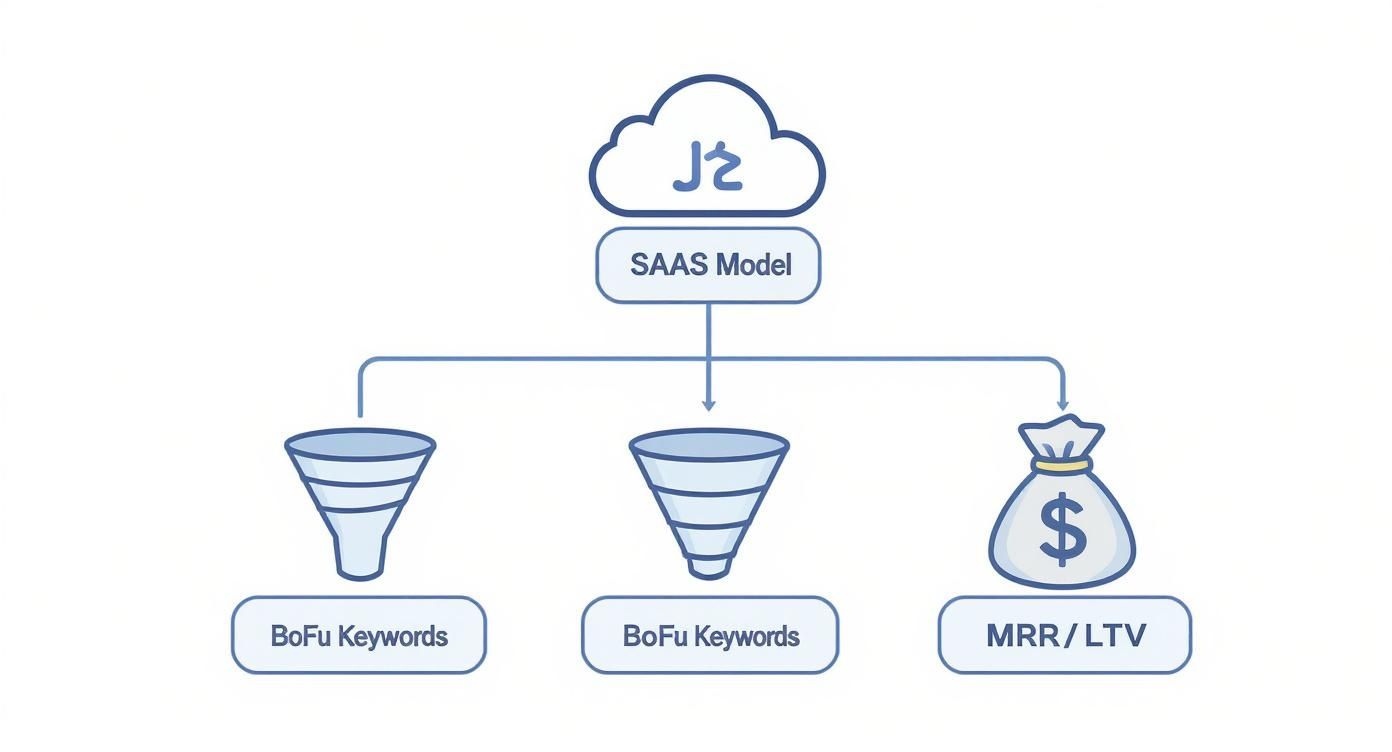
As the infographic shows, a thriving SaaS business needs a strategy that pulls in high-intent users at the bottom of the funnel—the ones who are ready to sign up and drive revenue.
Pillar 1: Technical SEO for a Flawless User Experience
Technical SEO is the engine room of your strategy. It’s all the work done behind the scenes to make sure search engines can find, crawl, and understand your website without hitting any roadblocks. Even the most amazing content will go unseen if your site's technical health is a mess.
Imagine writing the best article in the world but hiding it in a library with flickering lights and no signs on the aisles. Nobody’s going to find it. Technical SEO is about turning your site into a well-lit, perfectly organized library that both people and search engine bots love to navigate.
For SaaS, this comes down to a few core components:
- Blazing-Fast Site Speed: A slow website is a conversion killer. Every extra second it takes to load sends your bounce rate soaring and tells Google your user experience isn't up to snuff.
- Mobile-First Indexing: Your site has to look and work perfectly on a smartphone. Google now primarily uses the mobile version of your site for indexing and ranking, so this is non-negotiable.
- Software-Specific Schema: Using schema markup like
SoftwareApplicationgives search engines a clear blueprint of your product—what it is, what it does, and how much it costs. This is how you land those valuable rich results.
A technically sound website is the foundation you can't afford to ignore. It makes sure all the effort you put into content and authority building actually pays off, instead of being wasted on a platform that can’t perform.
Pillar 2: Content That Converts at Every Funnel Stage
If technical SEO is the engine, content is the fuel. For any SaaS company, this means creating a smart mix of content that meets potential customers exactly where they are in their buying journey—from "I think I have a problem" all the way to "take my money."
The numbers don't lie. Globally, 93% of all online sessions kick off with a search engine. And for SaaS, organic listings capture a massive 70% of all clicks. Your goal is to land on that first page of Google, because a staggering 75% of users never click to page two. This is why a winning SaaS SEO strategy depends on mastering techniques for generating long-tail keywords that convert.
To connect with buyers at each step, you need to think in terms of a content funnel. Here’s a simple breakdown of what that looks like in practice.
SaaS Content Funnel Examples
By mapping your content to these stages, you build a journey that naturally guides prospects from awareness to decision, answering their questions every step of the way.
Pillar 3: Authority Building and Strategic Link Acquisition
Authority is the oil that keeps your SEO engine running without friction. It’s all about building trust and credibility, both with users and with search engines. The single most effective way to build that authority? Getting high-quality backlinks from other reputable websites.
Think of a backlink as a vote of confidence. When a major industry publication links to your content, it’s sending a powerful signal to Google that you’re a trustworthy source. This remains one of the most important ranking factors out there. For bigger companies, these same principles apply but at a much larger scale, which we cover in our guide on enterprise SEO strategies.
For SaaS, strategic link acquisition is all about quality, not quantity. One link from a top tech blog is worth more than a hundred links from spammy, irrelevant directories.
Here are a few proven tactics for building real authority:
- Digital PR: Create original research, data studies, or newsworthy content that journalists and bloggers actually want to cite.
- Integration Partner Links: Get your brand featured on the marketplace or integration pages of other software tools your customers use.
- Guest Blogging: Write genuinely helpful articles for respected publications in your niche, with a link back to your site.
- Review Site Mentions: Earn features and positive reviews on trusted software platforms like G2, Capterra, and TrustRadius.
When you combine these three pillars—a solid technical base, strategic content, and earned authority—you create a powerful, scalable channel for organic growth that keeps delivering long after you've done the work.
How to Choose the Right SaaS SEO Partner
Picking a partner to handle your SaaS SEO is easily one of the biggest growth decisions you'll make. This isn't just about hiring a vendor to fiddle with keywords; it's about finding a strategic partner who gets your business model and is obsessed with driving real results.
The wrong partner can burn months—or even years—of your time and money chasing vanity metrics that never actually turn into revenue. A true growth partner, on the other hand, becomes an extension of your team, building an organic acquisition channel that turns into a serious company asset.
Look for a Proven Track Record in SaaS
Your very first filter should be SaaS-specific experience. A generic SEO agency that helps local dentists rank on Google Maps has no idea how your sales cycle works. You need a team that speaks the language of MRR, LTV, and churn.
When you're vetting potential partners, demand to see case studies that show more than just a nice-looking traffic graph.
- Focus on Business Outcomes: Ask for examples where they directly helped lift free trials, demo requests, or paying customers. The best saas seo services providers can draw a straight line from their work to your revenue.
- Demonstrable MRR Growth: Look for proof of their impact on Monthly Recurring Revenue. For instance, a campaign that boosted organic sign-ups by 40%, leading to a concrete dollar amount in new MRR.
- Deep SaaS Understanding: Their strategy should show they get the SaaS customer journey—from top-of-funnel educational articles to bottom-of-funnel competitor comparison pages.
Vet Their Strategic Approach and Transparency
A great SaaS SEO partner won't just tell you what they're going to do; they'll explain why they're doing it. Their strategy should be a clear, logical plan designed for your specific goals and market, not some cookie-cutter checklist they use for every client.
Your SEO partner should be an open book. If they can't clearly articulate their process or connect their SEO efforts to your business goals with transparent reporting, consider it a major red flag. Vague promises and "secret sauce" methodologies have no place in a professional partnership.
To really dig into their strategic thinking, you have to ask the right questions. This is how you separate the real experts from the pretenders. If you need more guidance on what to ask, our deep dive into SaaS SEO consulting offers a solid framework for these critical conversations.
Here are a few essential questions to throw at any potential agency:
- How do you prioritize keywords for different stages of the SaaS funnel? Their answer should show they know how to target problem-aware, solution-aware, and product-aware searchers.
- How will you measure the ROI of this SEO campaign? You want to hear answers that focus on metrics like organic-to-paid customer conversion rates, cost-per-acquisition from organic search, and the lifetime value of customers who found you through SEO.
- What is your approach to building authority and acquiring high-quality backlinks? They should be talking about a strategic process involving digital PR, content promotion, and relationship-building—not just buying links.
- Can you show me an example of a client report? The report should be clean, concise, and focused on the business metrics you care about, not just a bunch of keyword rankings and traffic numbers.
Common Red Flags to Watch Out For
Knowing what to look for is only half the battle; you also need to know what to avoid. The SEO world is full of providers who make huge promises they can't possibly keep.
Keep a sharp eye out for these warning signs:
- Guaranteed #1 Rankings: Nobody can guarantee a specific ranking on Google. This is an old-school sales trick used to close deals and a dead giveaway of an untrustworthy provider.
- Fixation on Vanity Metrics: If their entire pitch is about boosting traffic or ranking for a few broad keywords without tying it to sign-ups, they don’t understand SaaS growth.
- Lack of Transparency: If they get cagey about their methods or won't explain their process in detail, it's time to walk away.
- One-Size-Fits-All Packages: Every SaaS business is different. A partner offering rigid, pre-packaged SEO plans isn't prepared to build a custom strategy that will actually work for you.
How Much Does SaaS SEO Cost? A Breakdown of Pricing Models
Trying to pin down the cost of SaaS SEO is a bit like asking, "How much does a car cost?" The answer is always, "Well, it depends." Are you looking for a reliable daily driver or a high-performance sports car? The price tag is tied to your goals, the competition you're up against, and the scope of work required to win.
The goal isn’t to find the cheapest option. It’s to find a pricing model that fits your growth stage and actually delivers results. Let's walk through the common structures you'll run into.
The Monthly Retainer Model
This is the gold standard for most serious SaaS SEO campaigns. You pay a fixed fee each month for an agreed-upon scope of work, which usually covers everything from technical audits and keyword research to content creation and link building.
- Pros: Gives you predictable budgeting and allows for a real, long-term strategy to take root. It also fosters a deep partnership where your SEO provider becomes an extension of your team.
- Cons: It requires a longer commitment to see the full ROI and can feel like a big investment upfront if your budget is tight.
A monthly retainer isn't just about paying for a set number of hours. It’s about securing ongoing strategic thinking. It means your SEO partner is constantly digging into performance data, adapting to algorithm updates, and jumping on new opportunities as they pop up.
Project-Based and Performance-Based Fees
These models are less common for ongoing SEO but are perfect for specific, well-defined needs.
Project-Based Pricing: This is your go-to for one-off tasks. You pay a flat fee for a single deliverable, like a deep-dive technical SEO audit, a foundational content strategy, or a targeted backlink campaign. It’s a great fit for companies that need specialized help without signing up for a long-term commitment.
Performance-Based Pricing: You'll see this one less often because so many external factors influence rankings. Here, an agency might tie its fees directly to results—say, paying based on how many keywords hit page one or the percentage increase in organic trial sign-ups. It perfectly aligns incentives, but structuring a fair deal can get complicated fast.
Setting a Realistic Budget
So, what should you actually expect to invest? The cost varies wildly depending on how competitive your niche is and how aggressive your growth goals are.
For some context, high-growth, venture-backed SaaS companies often put 10% to 20% of their Annual Recurring Revenue (ARR) toward marketing. Of that budget, SEO campaigns typically get 20% to 30%. More bootstrapped or capital-efficient companies might invest closer to 5% of ARR in total marketing. If you want to dive deeper, you can find more SaaS marketing spend statistics to benchmark your own budget.
Here’s a rough idea of what you can get at different investment levels:
- Entry-Level ($3,000 - $7,000/month): This covers the fundamentals—technical audits, on-page optimization, and some limited content creation. It’s a solid starting point for early-stage startups in less crowded markets.
- Mid-Tier ($7,000 - $15,000/month): Here, you get a comprehensive strategy with consistent, high-quality content, strategic link acquisition, and a focus on conversion rate optimization. This is for growth-stage SaaS companies ready to compete seriously.
- Enterprise-Level ($15,000+/month): Think aggressive, large-scale campaigns. This level includes digital PR, programmatic SEO, and advanced analytics designed to dominate highly competitive markets.
The key is to see SEO not as a line-item expense, but as a strategic investment in building a predictable, long-term revenue machine.
Measuring SEO Impact on Your Bottom Line
Traffic graphs and keyword rankings look great on a slide deck, but they don't keep the lights on. The real test of any professional SaaS SEO service is its ability to turn organic growth into cold, hard cash.
To do this, you have to stop obsessing over vanity metrics and start tracking the key performance indicators (KPIs) that actually matter to your bottom line. It’s all about connecting the dots from a Google search all the way to a new paying customer.
Your dashboard shouldn't just be a traffic chart. It needs to tell a story your leadership team actually cares about: revenue.

Connecting SEO Efforts to Revenue
First things first: you need to track the actions that signal real buying intent. Think of these as the small steps that lead to the giant leap of a new subscription. You need to be able to confidently answer, "How many valuable actions did our organic visitors take this month?"
Your core metrics should zero in on these moments:
- Organic Free Trial Sign-ups: How many people started a trial after finding you through a search engine?
- Organic Demo Requests: How many prospects booked a sales call after landing on your site from a non-paid search?
- Conversion Rate to Paid: Of all those organic trial sign-ups, what percentage actually pulled out their credit card and became a customer?
Focusing on these bottom-of-the-funnel actions changes the entire conversation. You're no longer saying, "We got more traffic." Instead, you're saying, "We generated more qualified leads." This is how you frame SEO as a predictable revenue channel, not just another marketing expense.
Calculating the True Value of Organic Customers
Once you’re tracking conversions, the next step is to figure out what those customers are actually worth over time. This is where Lifetime Value (LTV) comes into play. LTV tells you the total revenue you can expect from a single customer throughout their entire relationship with your company.
To do this, you have to segment your customer data. Isolate the users who came from organic search and analyze how long they stick around and how much they spend on average.
You might be surprised. When you compare the LTV of organic customers to those from paid channels, you’ll often find that organic leads are stickier, more loyal, and ultimately more profitable.
This is the kind of data that builds a rock-solid business case for more investment. When you can show stakeholders that every dollar you put into SEO brings back a significant multiple in long-term revenue, getting the budget you need becomes a whole lot easier.
If you want to get into the weeds on this, check out our complete guide on how to measure marketing ROI and apply those same principles to your organic efforts.
Answering the Tough Questions About SaaS SEO Services
When you're looking into SaaS SEO services, a few big questions always come up. It's smart to ask them. Whether you're just starting out or trying to fix a strategy that isn't working, getting straight answers is the only way to set the right expectations.
Let's cut through the noise and tackle the questions we hear most from SaaS founders and marketers.
How Long Does This Actually Take?
This is always the first question, and the only honest answer is: it’s a long game. While you might see some small wins from technical fixes in the first 3-4 months, don't expect a sudden flood of new customers.
Real, meaningful results—the kind that show up as more free trials and a direct jump in MRR—usually take 6 to 12 months to kick in. Why so long? Because good SEO isn't about flipping a switch. It's about methodically researching, creating, and publishing killer content, earning Google's trust, and building backlinks in a market full of competitors.
A few things can speed this up or slow it down:
- Your website's current health and authority.
- How competitive your target keywords are.
- The pace and consistency of your SEO efforts.
Should We Do This In-House or Hire an Agency?
The choice between building an in-house team or bringing on an agency comes down to your resources, expertise, and how fast you need to grow.
An in-house team knows your product inside and out and fits right into your company culture. But hiring a full team of specialists is expensive, and it can take a long time to get them up to speed.
On the other hand, a specialized SaaS SEO agency gives you instant access to proven strategies, experienced experts, and the best tools on the market—all without the overhead of new salaries. Many of our clients find a hybrid approach works best, pairing their in-house marketing lead with an agency to handle the heavy lifting of strategy and execution.
The right move really depends on what you need. If you're looking for fast growth and a wide range of skills from day one, an agency is almost always the more direct route.
What's More Important: Content or Links?
This is the classic "chicken or the egg" debate in SEO. But for SaaS, the answer is simple: they are two sides of the same coin. You can't succeed with one and not the other.
Think of it this way: great content is your foundation. Without it, you have nothing for Google to rank and no reason for other sites to link to you. It's the price of entry.
But even the most amazing content will sit invisible without the authority that high-quality backlinks provide. A top-tier SaaS SEO services provider doesn't choose between them. They create standout content and then actively get it in front of the right people to earn the links that signal trust and authority to search engines.
Ready to turn organic search into a predictable revenue machine? PimpMySaaS specializes in building brand authority for B2B SaaS companies. We get you into strategic conversations on platforms like Reddit, cited in AI language models, and in front of buyers who are ready to make a decision. Find out how we can grow your MRR.