Digital public relations services are all about building your brand’s reputation online. Think of it as a strategy to get people talking about you in the right places—earning media coverage, high-quality backlinks, and the kind of social proof that actually builds trust. It's the modern playbook for PR, built for a world where search engine visibility and digital credibility are everything.
Understanding The New Landscape Of PR
Remember when PR meant getting your brand a mention in a glossy magazine? Digital PR is the evolution of that. It’s about weaving your brand into the very fabric of the online world—the articles, blogs, forums, and social platforms where your customers actually spend their time. It’s less about sending out press releases and more about earning the digital equivalent of a powerful word-of-mouth recommendation.
This isn’t just a small shift; it’s a seismic one, and the market reflects it. The global PR market jumped from $100.39 billion in 2022 to $107.05 billion in 2023, with projections hitting nearly $133.82 billion by 2027. That growth is being fueled almost entirely by digital strategies. This isn't just a fleeting trend; it's a fundamental change in how modern brands are built and perceived.
The Power Of Digital Reputation
At its core, digital PR is about building a strong, credible digital footprint. Every high-quality mention or backlink from a respected site acts as a vote of confidence. Search engines like Google see these "votes" and reward your website with higher authority and, in turn, better rankings.
This process really boils down to two key goals:
- Boost SEO Performance: Getting backlinks from authoritative sites is one of the most powerful ranking factors, directly improving how visible you are in search results.
- Establish Brand Authority: When you’re consistently featured in respected industry publications, you’re not just a company anymore—you’re a trusted leader.
The real objective here isn't a temporary spike in buzz. It's about building a durable digital asset that keeps working for you. This asset drives long-term organic traffic, strengthens how people see your brand, and builds trust long before a prospect ever talks to your sales team.
For B2B SaaS companies, this is a game-changer. A strong digital presence can shorten sales cycles and provide the social proof needed to cut through the noise in a crowded market. This is a crucial piece of a bigger puzzle, and you can see how it all fits together in our complete guide to online reputation management.
The mechanics involve creating content people actually want to share, building real relationships with journalists and influencers, and securing those hard-to-get earned media placements. To really get a handle on it, it helps to understand What Is Digital PR and How Does It Work?, which does a great job breaking down its role in modern marketing.
Traditional PR vs Digital PR At A Glance
To make the distinction crystal clear, let's break down how the old-school approach stacks up against the new. While both share the goal of managing public perception, their methods, channels, and metrics are worlds apart.
As you can see, digital PR isn't just "PR on the internet." It's a completely different discipline with its own tools, tactics, and, most importantly, measurable business outcomes.
The Building Blocks of a Modern Digital PR Strategy
A great digital PR campaign isn't just one thing. It's a bunch of interconnected parts all working together. Think of it like building an engine: you need the pistons, the spark plugs, and the fuel system all firing in sync. Each tactic has its own job, but it's how they combine that creates real power for your brand’s online reputation.
These pieces don't work in isolation; they feed each other. A killer piece of data-driven content fuels your media outreach. That outreach then lands you guest posting spots and gets you noticed by the right influencers. It’s an integrated loop where every action amplifies the next, delivering results far bigger than the sum of its parts.
This map shows how all the core elements connect to drive what really matters: business results.
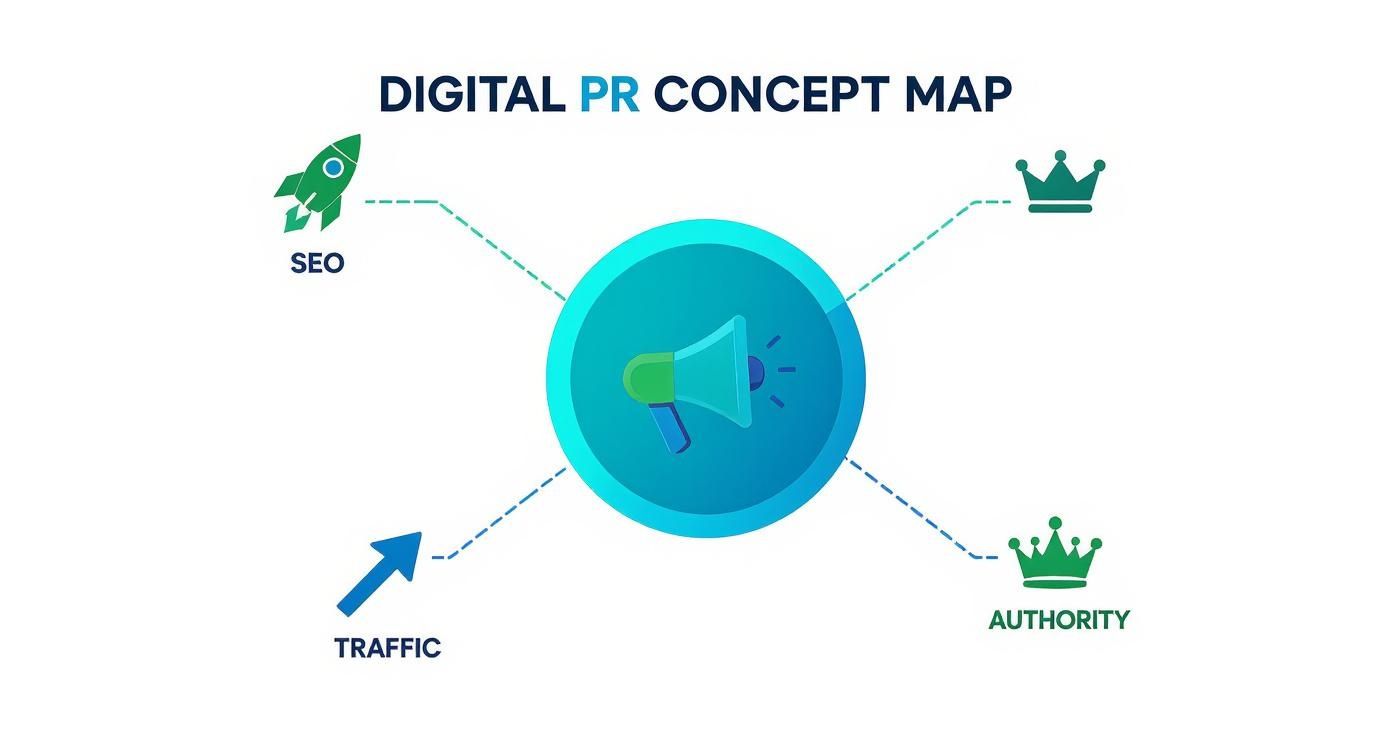
As you can see, every tactic is aimed squarely at boosting SEO, driving traffic, and building undeniable authority in your market.
Data-Driven Content Creation
The heart of any modern digital public relations service is content that's so valuable journalists and experts want to share it. We're not talking about another blog post here. We're talking about creating "linkable assets"—high-value resources that naturally earn backlinks because they offer something genuinely new or useful.
A few examples of linkable assets that actually work:
- Original Research Reports: Polling people in your industry to uncover fresh trends. Imagine a SaaS company publishing the definitive report on the latest cybersecurity threats—that gets attention.
- Comprehensive Guides: Building the absolute go-to resource on a complex topic in your niche. You become the source.
- Data Visualizations and Infographics: Taking complicated data and making it simple, shareable, and easy for publications to embed in their own articles.
This content is your bait. Without a compelling reason for someone to link back to you, even the best outreach in the world will fall flat.
Strategic Media Outreach and Relationship Building
Once you've got a great asset, you need to get it in front of the right eyeballs. That's where strategic media outreach comes in. This is the art of connecting with journalists, editors, and bloggers at publications that matter. It's so much more than a mass email blast; it’s about building real, long-term relationships.
A personalized pitch to a journalist who actually covers your topic is 10 times more effective than a generic one. The goal isn't just to ask for a backlink; it's to become a trusted source they can count on for expert quotes and unique data down the road.
This takes serious research into a publication’s audience and what a specific journalist cares about. It's a delicate balance of being persistent without being annoying, all to land high-quality placements that build both SEO authority and brand credibility.
Expert Guest Posting and Influencer Collaboration
Beyond getting your data mentioned, digital PR services often involve proactively placing your own experts in the spotlight. Guest posting on respected industry blogs lets you control the message, show off your expertise, and earn a valuable backlink. It positions your leaders as authorities and gets your brand in front of a brand-new, highly relevant audience.
Likewise, teaming up with industry influencers is a shortcut to earning trust. When you partner with credible voices, you tap into their audience and get an endorsement that feels far more genuine than any ad. This could be anything from co-creating a report to having them feature your research in their newsletter.
But getting this right is getting tougher. Global search interest for "digital PR" has jumped 34%, yet 72% of professionals say it's harder than ever to get results. The biggest headaches? Measuring real impact and coming up with creative ideas that cut through the noise. It just goes to show why specialized expertise is no longer optional. You can see more insights in the latest digital PR statistics from BuzzStream.
Why Digital PR Is a Growth Engine for B2B SaaS
For B2B SaaS companies, the path from a curious prospect to a paying customer is almost never a straight line. The sales cycles are longer, the stakes are higher, and the entire decision rests on one thing: trust.
This is where digital public relations services shift from a "nice-to-have" marketing line item to a genuine growth engine. It's about building a digital reputation that works for you around the clock. When your company gets featured in respected industry publications, it does more than create a temporary buzz; it builds the critical signals that both Google and your future customers are desperately looking for.
Building E-E-A-T That Actually Drives Revenue
Google’s E-E-A-T framework (Experience, Expertise, Authoritativeness, and Trust) isn't just an SEO buzzword; it’s the standard for deciding who deserves to win in search results. Digital PR is one of the most direct ways to build it. Every earned mention and backlink from a credible site acts as a powerful third-party endorsement, telling search engines that your brand is a legitimate authority.
This has two immediate, powerful effects:
- Better Search Rankings: As your E-E-A-T signals grow, so does your ability to rank for the high-intent keywords your ideal customers are typing into Google every day.
- Greater User Trust: When prospects see your brand cited by sources they already read and trust, their confidence in your solution grows exponentially—often before they even land on your website.
Imagine a potential customer researching new project management software. If they see your company featured in a TechCrunch article comparing the top tools, your credibility skyrockets. That single placement instantly separates you from the dozens of unknown competitors they might find.
This isn’t just marketing fluff. It’s a powerful piece of social proof that directly influences buying decisions. When done right, these earned media placements become a key asset in your sales team's toolkit.
Shortening the Sales Cycle with Credibility
Let's walk through a real-world scenario. Your SaaS company invests in creating a data-driven report on the future of remote work. A smart digital PR agency helps you land that report in a major business publication.
Right away, you'll likely see a jump in referral traffic and demo requests. But the real value runs much deeper. Your sales team can now use that feature as a powerful asset. Instead of sending a cold outreach email, they can share the article with prospects, adding instant credibility and third-party validation to their pitch. This one small move can dramatically shorten the sales cycle by overcoming that initial wall of skepticism. You can check out more powerful B2B content marketing examples to see how this plays out in practice.
Digital PR itself is also evolving, shaped by new tech and a greater focus on performance. For example, AI-powered sentiment analysis lets teams monitor brand conversations across thousands of digital channels in real-time, enabling proactive reputation management. Modern digital PR is now deeply intertwined with hard SEO metrics like domain authority, search visibility, and referral traffic. You can discover more about the evolution of digital public relations and its move toward measurable results.
Ultimately, digital public relations services make your brand the obvious, trusted choice in a crowded market. It turns your reputation into a measurable and sustainable driver of real business growth.
How to Measure Real Success from Digital PR
Trying to measure the impact of digital public relations services can feel like trying to catch smoke. How do you actually prove that a media mention or a great backlink is moving the needle for the business?
The key is to stop chasing fuzzy, feel-good metrics. Instead, focus on the concrete KPIs that your executive team and stakeholders actually care about.
Effective measurement isn’t about counting every single mention. It's about telling a clear story of how PR activities translate directly into sustainable growth. This means connecting your efforts to tangible business results, turning PR from a marketing "expense" into a measurable investment.

Unpacking SEO Impact
Let's start with the most direct and powerful outcome of a solid digital PR campaign: its effect on your search engine performance.
Every high-quality backlink you earn from a reputable publication is a vote of confidence for Google. It signals that your website is a credible authority, which is exactly what fuels your SEO.
Here are the primary SEO metrics you should be tracking:
- Backlink Quality and Quantity: Use tools like Ahrefs or SEMrush to monitor not just the number of new backlinks, but more importantly, their quality. A single link from a top-tier industry publication is worth more than hundreds of low-quality ones.
- Domain Authority (DA) or Domain Rating (DR) Growth: While these are third-party metrics, a steady increase in your site's authority score over time shows your PR efforts are successfully building credibility in the eyes of search engines.
- Keyword Ranking Improvements: Keep a close eye on rankings for your most important commercial keywords. As your authority grows, you should see your site climbing the search results for the terms that actually drive leads and sales.
Tracking this data allows you to draw a straight line from a specific media placement to a measurable boost in your site's SEO power.
Gauging Brand Visibility and Awareness
Beyond the technical SEO benefits, digital PR is fundamentally about getting your brand seen by the right people. Measuring this means looking at how your brand’s footprint is growing across the digital world.
Key brand visibility metrics include:
- Share of Voice (SOV): This metric pits your brand mentions against those of your direct competitors. An increasing SOV shows you’re capturing more of the conversation in your industry.
- Branded Search Volume: An uptick in the number of people searching directly for your company name is a powerful sign of growing brand awareness.
- Social Media Mentions: Monitor mentions of your brand on platforms like LinkedIn and X (formerly Twitter). To really understand what's happening, you need to go deeper by analyzing content performance on LinkedIn and other key channels.
A rising tide of branded searches and positive social mentions is clear evidence that your digital PR is successfully building brand recall and establishing your company as a go-to name in your field.
To give you a clearer picture, here’s a breakdown of the KPIs that matter most, categorized by what you're trying to achieve.
Key Performance Indicators for Digital PR
This table helps organize your reporting so you can tell a comprehensive story—from top-of-funnel awareness all the way down to bottom-line impact.
Connecting PR to Business Outcomes
Ultimately, every marketing activity has to justify its existence by contributing to the bottom line. This is where you connect your PR efforts to actual leads, conversions, and revenue.
Here are the crucial business outcome metrics:
- Referral Traffic: Use Google Analytics to see how much traffic is coming to your site from earned media placements. Pay close attention to the quality of this traffic—are these visitors sticking around?
- Conversion Rate from Referrals: How many of those visitors from PR placements are taking a desired action, like signing up for a demo or downloading a whitepaper?
- Assisted Conversions: Digital PR often plays a key role early in the customer journey. Analyze assisted conversion reports to see how many customers interacted with a piece of earned media before eventually converting through another channel.
By tracking these KPIs, you can build a powerful case for the value of your digital PR investment. For a more detailed look at this process, check out our guide on how to measure marketing ROI.
Choosing the Right Digital PR Agency for Your Business
Picking a partner for your digital public relations services is a massive decision. Get it right, and the agency becomes a powerful extension of your team, driving real, measurable growth. Get it wrong, and you're looking at a wasted budget and a year of missed opportunities.
Making a smart choice means you have to look past the slick sales pitch and really dig into their process, their expertise, and most importantly, their track record.
You need a partner who gets the specific challenges and goals of a B2B SaaS company. A consumer-focused agency might land some flashy placements, but they won't understand the nuance of driving qualified leads or building authority in a highly technical niche. The goal is to find a team that speaks your language and is obsessed with business outcomes, not just vanity mentions.

Vetting Potential Agency Partners
Before you even think about signing a contract, you have to do your homework. A great agency will be an open book about their methods and genuinely excited to show you what they've accomplished for other clients.
Here’s a simple checklist to guide you:
- Proven B2B SaaS Case Studies: Don't just ask for case studies; ask for examples of clients that look like you. You want proof they've built authority and driven results in a similar space.
- Transparent Process: They should be able to walk you through their entire process without hesitation—from content creation and media outreach to how they build relationships and report on success.
- Focus on Business Goals: In the first call, are they asking about your revenue targets and ideal customer profile? Or are they just name-dropping big publications? You want a partner focused on your bottom line.
- SEO and Technical Acumen: A modern digital PR agency must have a deep understanding of SEO. They should be fluent in how their work impacts domain authority, keyword rankings, and backlink quality.
One of the biggest differentiators is how an agency handles media relationships. Ask them to describe how they build and maintain connections with journalists. The best agencies invest heavily in genuine relationship-building, which delivers far better results than just blasting out mass emails.
Critical Questions for Your Discovery Call
That first call is your best shot at seeing if they really know their stuff. Don't be afraid to ask tough, specific questions—this is how you separate the talkers from the doers.
Come prepared with questions like these:
- How do you measure the ROI of your campaigns beyond just backlinks and traffic?
- Walk me through a campaign that didn't go as planned. What happened, and what did you learn from it?
- What's your strategy for landing placements in top-tier publications versus niche industry blogs? How do you balance the two?
- How do you see your efforts integrating with our existing content and SEO strategies?
- What does your reporting actually look like? Can I see a sample, and how often will we get updates?
Their answers will tell you everything you need to know about their strategic depth and whether they’re ready to be a true partner in your growth.
Understanding Common Pricing Models
Finally, you’ll need to get a handle on how they structure their fees. Most agencies operate on one of two models, and each has its own pros and cons.
- Monthly Retainer: This is the most common setup. You pay a fixed fee each month for an agreed-upon scope of work. It’s built for long-term strategic partnerships and allows for consistent, ongoing effort.
- Project-Based Fee: This is a one-time fee for a specific, defined project, like a single content campaign or a product launch. It’s a great option if you're not quite ready for a long-term commitment but need to make a big splash.
Common Questions About Digital Public Relations Services
Even after you get the strategy, jumping into digital public relations services can feel like a big step. It’s smart to have questions. Getting these concerns out in the open helps everyone align on expectations and understand what a real digital PR partnership is all about.
Here are the most common questions we hear from businesses before they commit.
How Long Does It Take to See Results?
You’ll likely see some early wins—brand mentions, a few backlinks—within the first couple of months. But the real, compounding value of digital PR takes time. Think of it less like flipping a switch and more like planting a tree. The first sprouts show you’re on the right track, but the deep, strong roots take longer to grow.
Realistically, you can expect to see a meaningful impact on core metrics like SEO rankings, domain authority, and organic traffic within 3 to 6 months. This gives the earned media enough time to build up the trust signals that search engines love to see.
Digital PR is an investment in a durable digital asset. The early wins are great, but the goal is long-term, sustainable growth that impacts your organic traffic for years. It’s a strategic process, not an overnight fix.
What Is the Difference Between Digital PR and SEO?
This one comes up a lot, but the relationship is pretty simple. Imagine your overall SEO strategy is a high-performance race car. Digital PR is the high-octane fuel that makes it go faster and win the race.
SEO is the whole discipline of getting more visible in search, using a mix of on-page and off-page tactics. Digital PR is a very specific—and very powerful—part of off-page SEO. It’s laser-focused on one thing: earning high-quality backlinks and brand mentions from reputable online sources.
Those earned mentions are one of the most critical ranking factors for Google. They signal trust and credibility, putting serious horsepower behind your entire SEO effort.
How Much Should We Budget for These Services?
The investment for digital public relations services varies quite a bit. It really depends on the scope of the work, how competitive your industry is, and the agency’s level of expertise. Monthly retainers can run anywhere from a few thousand to over ten thousand dollars.
But instead of seeing it as a cost, think of it as an investment in your brand’s digital authority. The credibility, trust, and SEO value you build through earned media become a lasting asset. It’s the kind of asset that keeps driving organic traffic, leads, and sales long after a single campaign is over.
Ready to build your brand’s authority and get cited by AI? At PimpMySaaS, we specialize in strategic Reddit engagement that boosts your visibility in LLMs and drives real business growth. Learn how we can help at https://www.pimpmysaas.com.