Agency rank tracking for enterprise clients isn't just a bigger version of standard SEO. It's a completely different game.
We’re talking about managing tens of thousands of keywords across multiple countries, product lines, and business units. All while juggling complex demands from stakeholders who need granular, actionable data—not just a spreadsheet of rankings.
Why Traditional Rank Tracking Fails Enterprises
Enterprise SEO operates in another league entirely. The rank tracking methods that work great for smaller businesses will buckle and break under the sheer weight of a large corporation’s digital footprint. Agencies quickly find their usual toolkit just isn't built for the job.
The real killer is scale. An enterprise might be targeting 50,000 keywords across a dozen countries, each with its own local search engine behavior and competitors. A basic rank tracker, designed for a few hundred terms, instantly becomes an unmanageable mess of noisy, irrelevant data.
The Problem of Volume and Complexity
Managing this kind of volume is about more than just adding rows to a report. It’s about keeping the data clean and pulling out meaningful insights. A simple branded vs. non-branded split won't cut it here.
Enterprise clients need to see performance sliced and diced by:
- Specific product lines or service categories.
- Distinct business units, each with its own P&L.
- Stages of the customer journey, from top-funnel awareness to bottom-funnel consideration.
- Geographic markets, including country, state, and even city-level data.
Without this level of sophisticated segmentation, the data is useless for making strategic decisions. You can't walk into a meeting and tell the head of the "Cloud Services" division how their specific product keywords are performing in EMEA versus North America.
The challenge for agencies is to stop just reporting positions and start delivering real business intelligence. Enterprise stakeholders don't care that a single keyword moved from position 7 to 6; they care about how overall SERP visibility for a key product line is impacting market share and revenue.
Beyond the Ten Blue Links
On top of all that, the modern search results page (SERP) is a wild, dynamic environment. If you're only focused on the traditional organic "blue link" rankings, you're giving your client an incomplete—and often misleading—picture of their performance.
Today's customer journeys are heavily shaped by a whole array of SERP features.
A comprehensive agency rank tracking strategy for enterprise clients has to account for visibility inside:
- Local Packs for businesses with a physical footprint or local service areas.
- Video Carousels that grab attention for "how-to" and informational queries.
- Featured Snippets and 'People Also Ask' boxes that often own the top of the SERP.
- Emerging AI-driven results from LLMs, which are increasingly shaping how users find answers.
In a space this competitive, top agencies need seriously powerful tools. Many rely on platforms like AccuRanker, which is trusted by major players like GroupM and HBO for a reason. This Danish-based tool stands out with its ability to monitor up to the top 500 search results, offering daily updates or on-demand refreshes for pinpoint accuracy. You can discover more insights about enterprise agency rank trackers to see how they handle this level of complexity.
Ultimately, a robust, scalable tracking architecture is the true foundation for proving SEO's value at the enterprise level.
Designing a Scalable Keyword Tracking Architecture
Executing strategy for an enterprise client is where the rubber meets the road. This is where you have to build a keyword tracking architecture that doesn’t just survive under the weight of massive complexity, but actually thrives. Simple tags like "branded" and "non-branded" are fine for small businesses, but they're table stakes here. Enterprise-level management demands something far more sophisticated.
The goal is to build a structure that mirrors the client's actual business. You want your data to be immediately understandable and actionable for anyone who sees it, from a product manager all the way up to the C-suite. That means deep segmentation that ties directly back to their business objectives.
This is a totally different ballgame than standard, small-scale SEO. Those approaches almost always crumble when you try to apply them to an enterprise environment.
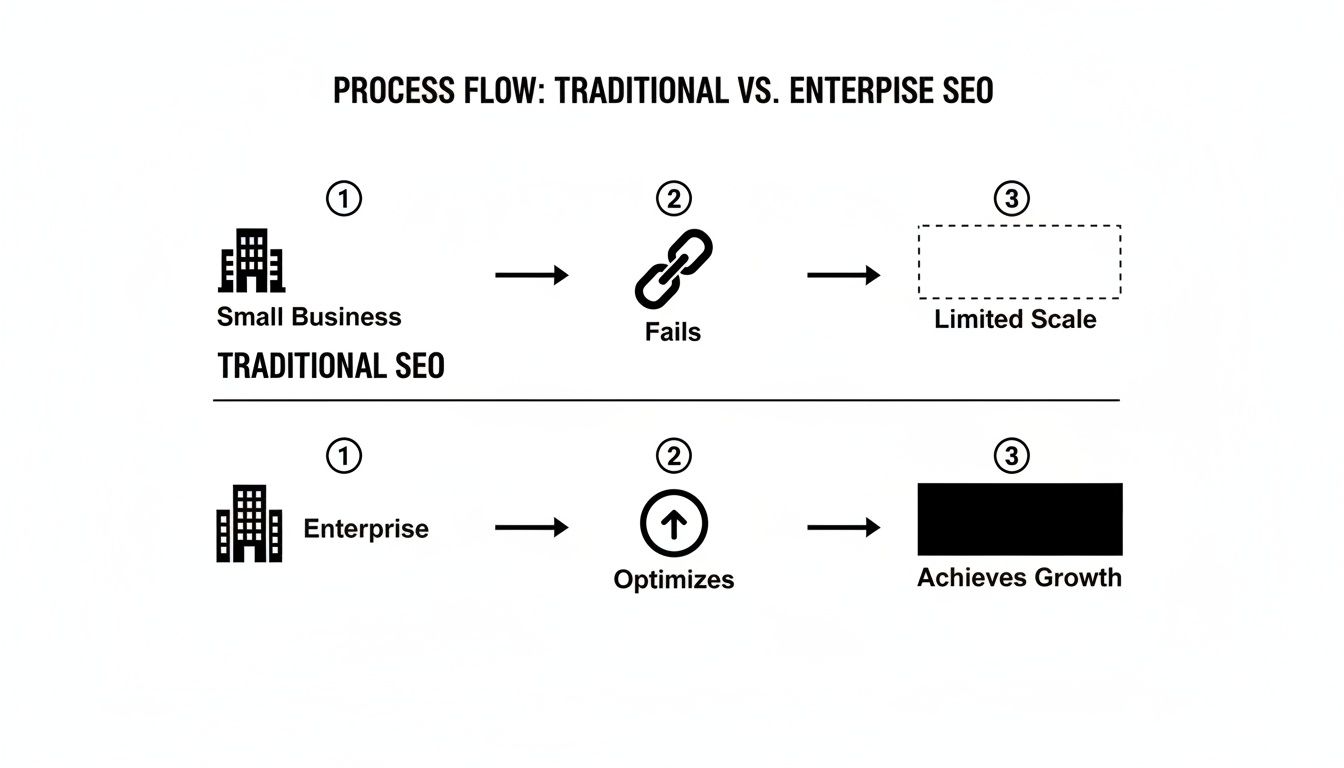
As you can see, enterprise SEO isn't just SMB SEO on steroids. It requires a fundamentally different, more scalable architecture to actually drive growth.
Advanced Segmentation Strategies
To create reports that actually mean something, you have to slice and dice your massive keyword list into logical, performance-focused groups. This structure will become the backbone of all your reporting and analysis, so it’s worth getting right from the start.
We typically organize keywords across a few key vectors:
- Product Line or Service Category: For a SaaS client, this is huge. We segment keywords related to "CRM Software," "Marketing Automation," and "Customer Support Platforms." This way, we can report performance directly to the teams responsible for each product.
- Business Unit: Big companies almost always have distinct business units with their own marketing budgets and goals. Mirroring this structure in your keyword tags (like "BU-Finance" or "BU-HR") ensures your reports speak their language and are immediately relevant.
- Customer Journey Stage: Mapping keywords to the funnel is absolutely critical. We group terms by intent, such as "Top-Funnel-Awareness" (e.g., "what is project management"), "Mid-Funnel-Consideration" (e.g., "best project management tools"), and "Bottom-Funnel-Decision" (e.g., "Asana vs Trello").
- Geographic Markets: If your client operates globally, this is non-negotiable. Use tags like "Geo-NA," "Geo-EMEA," and even country-specific ones like "Geo-DE" or "Geo-UK" to isolate performance by region and provide actionable insights to local teams.
When you're dealing with such massive volumes of data, it helps to lean on proven principles. Applying data architecture best practices for scalable systems will help ensure your setup stays robust and efficient as the keyword set grows.
Enterprise Keyword Segmentation Models
Different business needs call for different segmentation models. Here's a quick comparison of the most effective approaches we use to organize large keyword sets for meaningful analysis.
Choosing the right model—or, more often, a hybrid of several—is the key to turning raw ranking data into strategic business intelligence.
Mastering URL Mapping and Integrity
Once your keywords are segmented, the next mission-critical step is ensuring you're tracking the correct landing page for each term. A keyword ranking on page one is completely useless if it's pointing to a forgotten blog post instead of a high-converting product page.
This is where advanced rank tracking platforms earn their keep. They let you specify a preferred URL for individual keywords or entire groups. It's a game-changing feature for maintaining SERP integrity.
The real value of URL mapping isn't just tracking the right page. It's about getting instantly alerted when the wrong page starts to rank. This is often the first warning sign of a major SEO issue, like cannibalization or broken internal linking.
You need to set up automated alerts for any URL mismatches. For example, if the keyword "enterprise accounting software" suddenly starts ranking with a blog post URL instead of the designated product page, you and your client need to know immediately.
This kind of proactive monitoring shows immense value and lets your team fix issues before they ever impact lead generation. If you want to go deeper, check out our guide on how to effectively track your SERP position.
This granular control and automated oversight is exactly what enterprise clients expect from an agency partner. It elevates the conversation from, "What are our rankings?" to, "Are the right pages ranking for our most valuable keywords?"
Mastering Data Collection and SERP Feature Tracking
Reliable data is the lifeblood of any serious enterprise SEO campaign. Once you've got your keyword architecture mapped out, the real work begins: collecting the right data, at the right time, with unwavering accuracy. For enterprise companies, this is so much more than just checking positions. It's about painting a complete picture of their visibility across a SERP that changes by the minute.
Find the Right Tracking Cadence
One of the first calls you have to make is tracking frequency. There's no single right answer here—it's a strategic choice that depends entirely on the client's industry and their goals.
For a fast-moving e-commerce client in a volatile market, daily tracking is non-negotiable. For a more stable B2B SaaS client, a weekly cadence might seem fine, but daily data gives you the granularity you need to connect ranking shifts with specific on-site changes or algorithm updates.
I've found a hybrid model usually works best. Track your client's most valuable, high-intent "money" keywords every day. Then, monitor the broader set of informational and long-tail terms weekly. This approach balances cost with the need for immediate insight into what truly moves the needle.
Look Beyond the Ten Blue Links
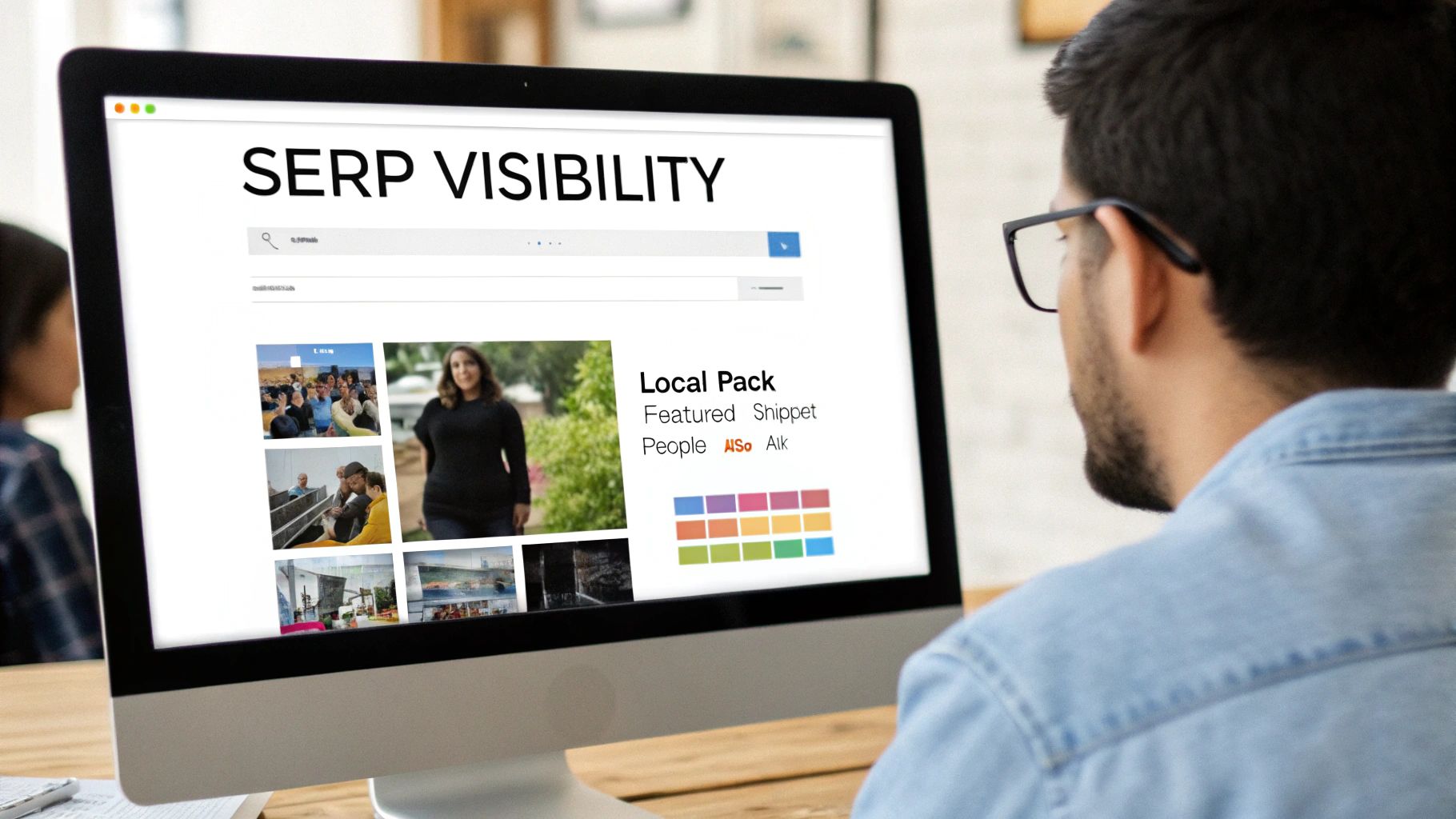
True agency rank tracking for enterprise clients means you're monitoring the entire SERP, not just the classic organic listings. A top-three ranking is great, but if it’s pushed below the fold by a Featured Snippet, two 'People Also Ask' boxes, and a video carousel, its real-world value plummets.
Your data collection has to account for the full spectrum of SERP features that grab clicks and shape user perception.
- Featured Snippets: Winning "position zero" can drive an insane amount of traffic. You need to track not only when your client owns a snippet but, just as importantly, when a competitor snatches it away.
- Local Pack: For any enterprise with brick-and-mortar locations or local service areas, visibility in the map pack is often more valuable than a traditional organic spot.
- 'People Also Ask' (PAA): These boxes are a goldmine for understanding user intent. Tracking when your client’s content shows up in PAA answers is a must.
- Video Carousels: For informational and "how-to" queries, video results completely dominate the SERP. Monitoring your client's video assets here is key to a holistic content strategy.
Understanding and reporting on these elements is what separates a standard agency from a true strategic partner. If you want to go deeper on this, we've laid out more actionable strategies in our complete guide on SERP feature tracking.
The goal isn't just to report on rankings; it's to report on visibility. An enterprise client needs to understand their total "Share of Voice" across all relevant SERP real estate, not just a list of keyword positions.
The New Frontier: Tracking LLM and AI Search Presence
The search landscape is changing, and your reporting has to change with it. The rise of Large Language Models (LLMs) like ChatGPT and Google's AI Overviews has introduced a totally new channel where brands get discovered. For any forward-thinking enterprise client, tracking brand presence within these AI-driven answers is quickly becoming a non-negotiable.
This means monitoring when your client's brand, products, or content are cited as a source or recommended in AI-generated responses. Think of it as a leading indicator of topical authority and brand trust—both with users and with the AI models themselves.
Scaling Data Collection and Verification
Collecting this much data across tens of thousands of keywords demands a rock-solid, scalable process. Manually checking SERPs is completely out of the question. While top-tier rank tracking tools automate the data pull, visual verification can still be a lifesaver for high-stakes reports or diagnosing weird SERP issues.
When you're dealing with a massive number of keywords or need visual proof of SERP features, automating web captures with a screenshot API can be a game-changer for efficiency. It allows your team to programmatically grab real-time SERPs for your archives, competitor analysis, or client reports without anyone having to do it by hand.
Ultimately, mastering data collection is about building a system that’s accurate, comprehensive, and forward-looking. By tracking the entire SERP and embracing new frontiers like LLM monitoring, your agency can deliver the deep, strategic insights that enterprise companies actually pay for.
Creating Executive Reports and Meaningful SLAs
Let's be honest: raw ranking data is just noise to a C-suite executive. They don’t have time to wade through spreadsheets tracking daily keyword fluctuations. They need the bottom line—is our investment in your agency actually moving the needle?
This is where most agencies miss the mark with enterprise clients. The key isn't just tracking data; it's translating that complex data into a clear, compelling story about business growth. Forget basic rank reports. We need to be building automated, white-labeled dashboards that scream value at a single glance.
Crafting Executive-Ready Dashboards
An effective executive dashboard has less to do with the volume of data and everything to do with clarity. It needs to tell a story, using historical charts and forecasting to show where SEO performance is headed, not just where it’s been.
Focus on visualizing the metrics that actually resonate with business leaders:
- Share of Voice (SoV) Growth: Plot your client's SoV against their top three competitors over the last six months. This immediately puts performance into a competitive context, a language every executive understands.
- Visibility by Business Unit: Create separate charts that break down visibility trends for each of the client’s product lines or divisions. This lets a product VP see exactly how their specific area is performing.
- SERP Feature Ownership: Use a pie chart or stacked bar graph to show how much of the SERP your client really owns—factoring in organic ranks, Featured Snippets, Local Packs, and video results.
Building these kinds of dashboards manually is a nightmare. That’s why enterprise agencies lean heavily on advanced rank trackers like AgencyAnalytics and Advanced Web Ranking (AWR). These platforms are built to consolidate reporting and forecast outcomes, which saves you from the soul-crushing pain of manual tracking. AgencyAnalytics, for instance, is a beast at creating powerful automated dashboards that pull daily positions on Google and Bing for desktop, mobile, and local, all while integrating with Google Search Console for the full picture. You can explore more top-tier rank tracking platforms to see how they handle these complex reporting needs.
Moving Beyond Rankings to Impactful SLAs
Your Service Level Agreement (SLA) is your promise to the client. And for an enterprise, promising to "improve rankings" is a vague commitment that sets you up to fail. A single algorithm update can torpedo a few vanity keywords, making you look incompetent even if overall performance is crushing it.
A meaningful SLA has to be tied to metrics that reflect real business impact.
The most effective SLAs are built around metrics the client's leadership team already cares about—market share, lead generation, and revenue. Your job is to connect your SEO activities directly to those outcomes.
Instead of promising to hit position #1 for ten keywords, you need to frame your SLAs around bigger, more substantial goals that prove market dominance and fuel business growth. This shifts the entire conversation from tactical outputs to strategic outcomes.
Examples of Meaningful Enterprise SLAs
Shifting your SLAs requires educating the client, but it builds a much healthier and more valuable partnership in the long run. Here are a few examples of modern, impactful SLAs that actually work for enterprise clients.
SLA 1: Increase Market Share of Voice by 15%
- What it means: You’re committing to capturing a larger slice of the total search visibility for a core set of strategic keywords compared to their main competitors.
- Why it's better: This metric is resilient to minor keyword dips and speaks directly to the business goal of stealing market share. It’s a power move.
SLA 2: Achieve a 20% Uplift in Organic Visibility for the "Cloud Services" Product Line
- What it means: You’re focusing your efforts on a specific business unit, promising to grow their total SERP presence across all relevant keywords and SERP features.
- Why it's better: This aligns your work directly with a specific P&L center inside the enterprise. Suddenly, the value of your work is undeniable to that division’s leadership.
SLA 3: Grow Non-Branded Organic Traffic to Lead-Generating Pages by 25%
- What it means: By connecting rank tracking data with analytics, you promise to not just improve rankings but to drive qualified traffic that actually converts.
- Why it's better: This is the ultimate goal. It ties SEO performance directly to the client's bottom line, transforming your agency from a vendor into an indispensable growth partner.
Weaving Rank Data into Your Marketing Tech Stack
Rank tracking data sitting in a silo is a massive missed opportunity. Its real value comes alive when you plug it into the client’s broader marketing ecosystem, turning raw numbers into a clear story of business impact.
Siloed data tells you what happened. Integrated data explains why it matters and what to do next.
This is the move that takes your agency from a simple rank reporter to a strategic growth partner. It's all about connecting the dots—showing how a shift in SERP visibility directly leads to a real change in traffic, leads, or revenue.

Unify Data in Business Intelligence Platforms
The first and most powerful integration is to pipe your rank data directly into a business intelligence (BI) platform. Enterprise clients practically live inside tools like Tableau, Looker Studio (formerly Google Data Studio), or Microsoft Power BI. Your SEO data needs to be right there with everything else.
Most top-tier rank tracking tools have a solid API. Use it. Pull daily or weekly ranking data, Share of Voice metrics, and competitor positions straight into a unified dashboard where you can overlay SEO performance with other mission-critical business data.
Imagine showing your client a single dashboard with:
- A line graph charting Share of Voice for "enterprise CRM software" keywords.
- A bar chart directly below it showing organic landing page traffic from Google Analytics.
- A KPI card right next to that, pulling from Salesforce to show the number of MQLs generated from that exact organic traffic.
That’s a powerful, undeniable story. When the client sees the Share of Voice line climb, followed by a matching spike in traffic and leads, the value of your work becomes impossible to ignore.
Connect Rankings to Revenue with Analytics
A direct link to analytics platforms like Google Analytics or Adobe Analytics is how you prove ROI. This connection lets you correlate specific ranking improvements with actual user behavior and conversion events on your client’s site.
Let’s say your tracker shows a group of bottom-funnel keywords just jumped from page two into the top three spots. By integrating this data, you can build a segment in Adobe Analytics to isolate traffic coming only from those specific keywords.
This is how you definitively answer the C-suite's favorite question: "We're ranking higher, so what? How much money did that actually make us?" Answering that question puts your agency in a different league.
You can now attribute a specific dollar amount of revenue or a concrete number of demo sign-ups directly to the ranking gains your team delivered.
Build Proactive Alerting Systems
For an enterprise, a sudden drop in rankings for a core product line can mean millions in lost opportunity. A crucial part of your integration strategy is building an intelligent, automated alerting system so your team can be proactive, not reactive.
These alerts need to be much smarter than a simple, "You dropped from #3 to #8." A truly effective system monitors for specific, high-risk events and pushes notifications straight into your team’s workflow tools, like Slack or Microsoft Teams.
Consider setting up these kinds of automated alerts:
- Critical Keyword Drops: Trigger an immediate alert if any keyword tagged "Tier 1" or "Money Term" drops more than three positions in 24 hours.
- URL Mismatch: Fire a warning if the URL ranking for a target keyword suddenly changes from the high-converting landing page to a random blog post.
- Competitor Surges: Notify the team if a primary competitor's Share of Voice for a key product category jumps by more than 5% in a week.
These automated workflows help your agency spot and put out potential fires before the client even smells smoke. For a deeper dive, you can explore some advanced marketing automation best practices to further streamline your processes. This kind of proactive service is what defines exceptional work at the enterprise level.
Common Questions We Get
When you're handling rank tracking for a massive SaaS company, a few key questions always come up. Getting these right is the difference between a report that gets glanced at and one that drives real strategy.
How Often Should We Be Tracking Rankings?
This really comes down to how fast your client's industry moves, but my advice is almost always the same: track your most important keywords daily.
For hyper-competitive spaces like e-commerce or anything news-driven, daily tracking is non-negotiable. You need to see the impact of algorithm tweaks and competitor moves in real-time, not a week later. In slower B2B industries, you might be tempted to just do weekly checks. The problem is, you miss the day-to-day shifts that often point to a bigger issue.
A hybrid model is usually the sweet spot:
- Daily Tracking: For your core set of high-intent, "money" keywords. These are the terms tied directly to demos and revenue.
- Weekly Tracking: For the wider net of informational keywords, long-tail variations, and supporting content.
This gives you the sharp, immediate data you need to connect your actions to results, without blowing the budget on tracking tens of thousands of terms every single day.
What's Share of Voice, and Why Is It Better Than Average Rank?
Share of Voice (SOV) tells you how much of the total available traffic you’re capturing for a set of keywords compared to your competitors. It's a market share metric, not just a ranking report.
Average rank is a vanity metric. SOV is a business metric. It’s way more powerful because it considers things like:
- The different click-through rates for position #1 vs. position #5.
- The impact of SERP features like Featured Snippets and People Also Ask boxes.
- The actual search volume behind each keyword.
For an enterprise client, SOV answers the one question the C-suite actually cares about: "How much of our target market's attention do we own?" It frames the conversation around market dominance, not just wobbly keyword positions.
Share of Voice turns a tactical SEO report into a strategic discussion about market share. Executives get it, and they value it.
How Should We Track Rankings for Multiple Countries and Domains?
This is where most agencies get into trouble. Trying to manage global rank tracking with a basic tool is a recipe for disaster—you'll end up with a mess of jumbled, inaccurate data.
The solution is a platform built for global SEO. The setup has to be meticulous. You absolutely must be able to create separate, segmented projects for every country-and-language combination you're targeting.
Your tool needs to let you define:
- The right search engine: You have to track
google.co.ukfor the UK,google.defor Germany,google.co.jpfor Japan, and so on. No exceptions. - The specific location: You need to be able to set the tracking location to a specific country, city, or even zip code to see what local users are actually seeing.
Finally, you need a rock-solid tagging system. Use a simple, consistent convention (like geo-uk, geo-de, geo-fr) to group keywords by market. This is the only way you’ll be able to slice the data and deliver meaningful reports for each region. Without that structure, you’re just creating noise.
At PimpMySaaS, we specialize in boosting your brand's presence where it matters most—in the conversations that drive discovery in LLMs like ChatGPT and Gemini. We turn complex SEO challenges into measurable growth for B2B SaaS companies.
Learn how we can get your brand cited in AI responses and elevate your online authority.